

 YouTube

 Spotify

 Apple Podcasts

 iHeartRadio

 Amazon Music

 Audible
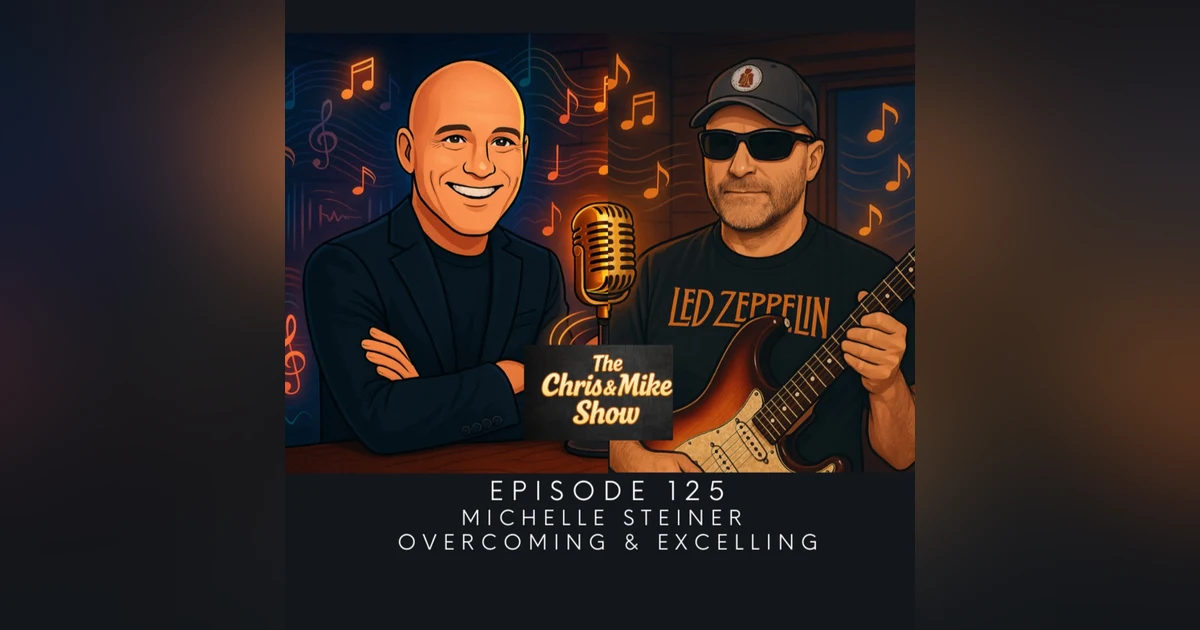
#125 - Michelle Steiner - Navigating Life with Disabilities
Hello Friends
In this engaging conversation, Michelle shares her personal journey with dyscalculia and the challenges she faced throughout her life. She emphasizes the importance of empathy, advocacy, and support systems in education, as well as the power of writing as a therapeutic outlet.
Michelle encourages others to find their strength in adversity and to pursue their passions despite societal stigma. Her mission is to empower individuals with disabilities through her experiences and insights, inspiring them to advocate for themselves and seek out the resources they need to succeed.
Subscribe and Comment at all our links below.
https://www.youtube.com/@chrisandmikeshow
0:01 Ha ha ha ha. What's up the boys and roses person like with our with our guest Michelle, ladies and gentlemen. So again, thank you for joining us. We are Chris and Mike and she's Michelle. This is Chris and Mike. So we are actually broadcasting live on the YouTube as well as Twitch right now. So I was talking to some of my son Jake earlier, Mike and I told him, dude, we'll be on YouTube at 3:00, join in. He's like, OK pops, I will even right on. Even though he's doing Marine things, you know, he can still he's in the office today.
0:54 So that's kind of fun. So we have, I'm in Arizona, Mike's in Illinois. Where are you at, Michelle? Pennsylvania. I see. I was going to say Pennsylvania pre show 'cause I kind of, I kind of picked up the accent. Yeah, right. And my wife's from Punxsutawney. I'm sure you know where that is. Yes, I I do. We're just an hour from Pittsburgh. So yeah, yeah, definitely. You could always pick up the the Pennsylvania. Accent, right? Good old Punxsutawney Phil. So are you a Steelers fan? Let's get the Let's get the serious stuff out of the way. Since you're from Pennsylvania, you're a Steelers fan. I'm not much into sports, but I of course, the Steelers, definitely. Yeah. I've always said a big one. Yep. Cool. So you're super excited about Aaron Rodgers being your quarterback. Now say no.
1:38 That answer would be no. Much into sports. Why? That's why you just say no. You just say no. I will ask my husband. Yeah, your husband will agree. It's I. Think he's probably going to say no as well. You. Know yeah, there's a meme out there where where he's on a it's it's it's an old guy I don't know who he is but he's like, you know just he was introducing their new quarterback and he's like an old dude on a Walker and. You know. Call it a career, man. Call it a career. So, OK, so we can't talk sports because she doesn't like sports. Wow. OK, that's fine. You know, everybody's a sports. Not like we are, but we're not really sports. Not we just live in the world. So watch it for. We do watch it for entertaining and fun, so let's chat a little bit about you, Michelle.
2:21 Where are you originally from? Pennsylvania. Yes. OK. And what is it that why are you here today? Why did you want to come on our show? Let's chat a little bit about that. Give us your give us your elevator speech. We're on an elevator with Mike and I. We're going up 30th floor. You got like a minute to tell us who you are and why you want to come on this rapidly growing, fast-paced, energized podcast that's taking over the world. 21 countries, mind you. That's good. That's good. Well, my name is Michelle Steiner. I live in Pennsylvania with my husband Ron or two cats, Jack and Sparrow. 2 cats. Is it from from Pirates of the Caribbean? Yes, when we adopted them that the people that we got them from were huge Disney fans and we thought the names were just so cute. We didn't want to change them.
3:08 Yeah. And that's right. And I also, I work in a school as a para educator or a teacher's aide with students who have disabilities. And I also, I'm a writer, I'm a speaker and I'm a photographer. And I have a blog called Michelle's Mission where I write about my life with having a learning disability. And my goal or the mission statement of where I'm at is to encourage, empower and educate people with and without disabilities. That's. Awesome. I'm Googling it right now. Michelle's mission, Where are you? Oh, that was weird. I went to AI mode. Wow, holy smoke. So Google has this AI mode and there's and OK, there's, there's lots of Michelle missions.
3:53 So how do I find you? I am ww.michellesmission.com. Yeah, that's what I did. Weird hold. On I can. Always get out of it. There you go, Michelle. Oh, Michelle's mission. There's my dad. I did, I did. I didn't pluralize that. Got to pluralize it Got to. Pluralize it plural, Plural I. Can always put the link in the chat too, no big deal. You're all good, Michelle. Commission there. It is a blog to encourage, empower and educate people with and without the abilities. I like that. Outstanding. And you have a podcast. I don't have a podcast but I put where the links of where I podcast up and.
4:36 On I've been on a lot of podcasts. Wow, this is going. To be the most fun one you've ever been on, ever, in your entire life. Of. Course, we guarantee it. You're just going to be. Like wow, where these guys been all my life. Find your waves and sword. I like that. I like that very cool. And and so the nice thing about this, people watching and and tuning in on YouTube and Twitch pluralize it. Michelle's mission.com on the top, it has her, her Instagram, her Facebook, all the resources, how to contact her. There's a press, there's there's all the news articles and stuff. There's a store. The podcast has been on our social feeds and her blog itself. I'm a huge Blogger too, so I dig the whole blog concept, so I love that. And do you blog actually on the site or is it somewhere else? You blog in the RSS feed it.
5:22 I blog on the site. OK, cool. Right on. Outstanding. Wow, that's a lot of blogs man. Yeah. How long have you been doing that? I've done that for about 5 years now. I started whenever the pandemic began. I had a grant from Disability Pride in Philadelphia, so that that encouraged me to start that, but I wrote about having a disability a few years prior to that. In fact, writing and reading has always been really big in my life, especially when I was in school and I was being bullied as a kid. I really writing and reading became my world. And I was really lucky as a teenager that I found an adult writing group whenever I was 16 or 17. And I mean, these people really encouraged me to write about having a a disability.
6:16 And 20 some years later, we still meet once a month to talk about her writing and we're in each other. It's so cool. Yeah, at the time, though, I decided, oh, I'm just going to put that on the shelf. That's way too personal. And I, I've read some really bad poetry and some other things I don't, would not want to read today. But when I finally. Everybody's got to start somewhere. Yeah, exactly. For the people that are listening at home, obviously you know you're talking about having your own disabilities. Reading and writing are not one of them. So what are your disabilities? I have dyscalculia which is a math disability I have. What is that for the Yeah, explain I don't even know what. I don't know either so. Treat us. Like we're five year olds and give us the kindergarten.
6:59 Right when you have this calculia it it it means that I have trouble with math, but it goes beyond just being bad at math. This is something where I can understand very basic concepts, but it it capped off at a very early stage of that. And I also it it impacts me outside the classroom. I will confuse my right for my left. I cannot read the face of an analog clock, despite having many interventions with that. Still to this day. Yep, still to this day. That's crazy. Yeah, I mean, if you give me a running start, I can usually keep track of it. But if I was just do a blind read I I can't tell you what time it is and. So now with the math, is it just something you cannot do? Can you not put the numbers together? Does it get scrambled in your brain or, you know, kind of describe to myself and the people that are listening, what are you experiencing when you're trying to do math? Where the rest of us, I'll say we suck at it, but we can figure it out, right?
7:59 Right. Well, for me, I have not memorized all my addition, all my subtraction, multiplication, all those tables have not have that memorized. But even if you would give me a calculator, it's still really a struggle for me past a very basic level. It's just really trying to figure out how numbers will work. So you might give me a formula and sometimes that working memory doesn't, just doesn't do that. We, we don't know for sure why certain people are just really bad at it or really and why people have that. But I'm not, I've always struggled with that. I've get the worksheets and I could, I just couldn't do a lot of that. And I really had a lot of difficulty.
8:40 And I mean, it can everything is what we might even say goes to one source. I mean I'm also not able to drive but that also is the visual perception and it also goes to the index. Everything just seems like it comes to a brain based SO. Do you not have the proper depth perception? Is that why you can't drive? Exactly. OK, wow. So the first time I ever got high, I felt like I was, this is like when I was in high school. OK, so I'm not, I'm not the Stoner or anything, but we talked about this on our Ozzy Osbourne tribute show, 'cause you realize the first time I ever, it was not a bad thing, but some people, you know, so I don't think Jake ever realizes that I, I got stoned. So now if my son's watching, he's really what dad? So, right, Why Mike? So that was an accident.
9:24 So, but, but I remember the first time ever doing that because it was with my brother and a couple of his friends and there's a whole peer pressure thing, you know, you got to do this man, because, you know, whatever Ozzy was playing and that was my first introduction to Ozzy. So by the time he kicked in and we went home to get money, go to 711 munchies, I, I remembered I felt like I was walking on the moon, right. So, and so that in my head obviously was a depth perception thing because I thought, I thought the ground was, was a lot. I don't know if it was lower or higher. So. You felt like your feet were way off. The ground so was, so was. So the reason I'm, I bring this up because I want to, I want to compare is that, is that what depth perception's like for you, the visual perception like you just you don't, you don't know how to. I don't want to sound stupid, but you don't like you put your foot down, but in your brain like oh shit, is that actually the ground?
10:08 So is an easy way for you. It does. OK. An easier way for you to make sense of it, Chris, as a driver is you can tell how quickly you have to slow down based on how far the truck or the car in front of you is correct. OK, OK. She would never be able to do. That she would. Rear end people all the. Time I would because I mean I she. Can't tell how far that is in front. Of her that's what your. Depth perception does. Right where I am, like, in space. I mean, gym class was a nightmare for me. I'll clinch every time a ball comes in my direction. I bet. Yeah. So that was really hard for me to be able to do a lot of that. And my parents kind of knew whenever I turned 16 that this was going to be an issue.
10:53 We didn't know how big of an issue it was going to be though. So we waited a year and then they have, we've lived out in the country and they had me do little things before we even considered studying from a test or anything. They, we have this field and they said, well, why don't you go mow the field? And instead of making these perfect straight lines, I ended up making circles. So I always say that I know. I now know where crop circles come from. It's Michelle did it. Michelle did it. You've heard it here 1st and the Chris and Mike showed the crop circle epidemic and solved mystery has been solved. It's Michelle.
11:34 Michelle did it Roof. That's great. I love. It and then my parents had me drive up. We had a really long drive late. I was in the car with my mom and she said, well, do you want to drive? And I said, OK. So we drove up the driveway and thank God my mom was in the car with me or else I would have crashed into the family garage. And this is what my mom said. This is beyond just somebody. It's not going to be the, the next greatest athlete or something to that extreme. We knew that this was going to have to get looked at. So I was really lucky. I got connected with an agency called Office for Vocational rehabilitation. And they paid all for all of my years of college, but they also paid for me to get a driver's license evaluation. They, they don't do that now.
12:21 They won't pay for it, but they did in the past. Thankfully they did. And it was at a rehabilitation hospital. And I can remember we went through a whole battery of tests. I mean, I went, I passed I knew what to do if the car broke down. I, I knew, you know what, what perhaps I was the responsibility of being a driver, the vision test, perfect vision to be able to pass that. And then we got to the, the last part, which was visual perception. And she said, based upon your score, I don't think that it's wise for you to get your license at this time. And it just felt like 100 lbs was lifted off of me at that. Point so So here's a question. So you're 16. When did when did this condition start presenting itself? Were you younger and just didn't realize it? It did when I was in kindergarten. They knew when I, when I was very young that I had that I went to the eye doctor and they gave different things for me to do to try to with my visual perception, with my, with my eye hand coordination.
13:17 I remember my dad, he had a wiffle ball or a bat and then like a wiffle ball and he tied it to the ceiling and then that I had to hit the ball. That was one of my exercises and I had to walk. He made a balance beam for me and I walked across that, but. How hard? How hard was it to hit the wiffle ball hanging from the ceiling? I mean, it was somewhat of a challenge, but I got better at got better at doing that. You know, we tried to do different things to try to see if that was going to work or not and just, yeah, it, but it really didn't work in that thing. But I mean, I haven't let it stop me. I still go to the gym and I'll still go to group exercise classes. And I just have to realize, OK, yeah, these people are. I just have to make enough space and yeah, and just give myself that grace and do stuff like that. But that was one of the big factors that they did with with, yeah, just seeing about driving.
14:12 Do you feel like because you've been disadvantaged in these several ways, do you notice things that you're better at than other people? Are you aware of those things? Yes, one of the things is with taking. I'm also a photographer and people will tell me that I bring out the details in a flower that they miss. And when I don't get a, when I don't have a ride, I mean, I'm really lucky my husband can take me to work. I have a great Co worker who takes me home at the end of the day. But sometimes I don't have a ride to get places and I live in a central location. So I get that's that literally that chance to stop and smell the roses. And I get to notice these, these details that other people don't get to see. I get to see the flower. I get to see other really neat things and I can capture that and I just think to myself, rather than being sad, that's something that I'm able to do that other people don't get that chance because they're busy in their lives. So you find yourself literally stopping to smell the roses. You're paying attention to detail in things that you notice other people just whizz on by and don't even give it a second thought.
15:17 Nope, they don't. That's. Really cool. That is cool. And another thing too, I think is empathy. When I work with my students, I'm able to really understand what a lot of them are going through. Not every single one, but a lot of times it's like hearing a recording of myself. I hate my disability. I wish I didn't have it. I'm not smart. And I get to tell them it's not a bad thing to have a disability and I get to show them how to advocate. And I think I would always be geared towards helping people, but I don't think I would know how it it would honestly feel if I didn't go through it myself. I don't have, I don't have a disability, but where I'm going to be able to sympathize with you and I'm going to have gone through the same thing is I had allergies when I was a kid. So obviously kids, I guess you could say I was bullied, but you know, I got tired of hearing about it. It's like you can't do this, you can't do that. You know, kids are mean.
16:14 But the other thing is I was sick a lot. So I was isolated. I couldn't go out for recess. I couldn't participate in gym class. So I spent a lot of time reading, you know, and by myself with the teacher And the empathy part, I really, I, I, that really hits me hard because I think a lot of my empathy came from that. You know you can see when other people are different or disadvantaged than you are. You're not going to be the first person to make fun of that person, right? You're going to try and pick them up however you can. Exactly. And that is one of the things you can. Yeah. You're not what you're going to be able to uplift them. And I also show them how to advocate. And I always just say this, that for my students, one day will end up leaving me.
17:00 And I hope that they're able to graduate, achieve every single dream that they went after. But for a lot of them, their disability is going to stay. So they have to learn. Yeah. And the power that you have having those, those disabilities, they have something to relate to, which is cool because like, like, like my grandson, a little man, he has a little bit of speech issue. So he has to go to a speech therapist to kind of work with, you know, certain annunciations like the TH sound, you know, what's the last one we did? But I could see if we can't get that cured as he goes moves along in school, he's going to get bullied in TS and things like that.
17:40 And to me, it's it's always more impactful when the person that in your case you're you're you're helping the students around you, but you've been there, done that. So they have somebody they can they can attach themselves to. You know what I mean is am I making am I making sense? Absolutely. Sometimes I don't feel like I'm making sense. So but you have that experience, you know, like been there, done that. So you know, the struggle is first hand. You know what it's like to go to school and get, like Mike said, picked on, maybe bullied, things like that, because you're just a little bit different than the norm. That I think is is really cool that you do that because it is it should give them, empower them. That's what I was looking for. It should be able to empower them more because hey, Michelle, Michelle overcame this and now look what she's doing. She's helping others and she's got a blog and she's got this, you know, all these different outlets that she's doing. That's cool that I like that.
18:27 I like the fact that you're using that as a vehicle to help others and and you know, bring light to their lives as opposed to them just, you know, everybody because when you have those kind of things, right, there's a depression that can set in, right? What was me? Why am I different than self pity and all that especially? When you're getting picked on constantly, right? Yeah. Exactly. And that's one of the things, a lot of them, I'm. I'm also really good at with kids that might be getting bullied by somebody else. Yeah. What do you tell these? Kids, I would be interested for the people that are listening at home, if they have family members with special needs, maybe this will be something that'll help them. What do you tell those kids that come to you? And they say, you know, Miss Michelle, I'm getting bullied all the time.
19:08 What do I do, you know? Well, one of the things I do is I always give them the option if they want to report it, it's always an option. I say it's your choice. But I said there are some things you might be able to do that might help you belong. Like for example, if it's the lunch room and somebody's sitting at your lunch table and you're getting picked on, maybe go try sit at somebody else's table because and then if they ask you about it, just be like, OK, just trying out a different lunch table. I mean, the little things like that, I try to tell them to not to not to give that ammo to, you know, fueled with a fire either. So if you know that somebody that's going to make they know that it's making you upset, that's going to make it a lot worse. So sometimes just maybe ignoring certain things. I mean, obviously if it does involve something that's abuse, we do want that to be taken care of and handled. But I find that a lot of times when kids just learn. That, you know, it's, I'm not going to show that it really bothers me.
20:08 Don't move on to pick on to somebody else. And that's what I try to deal with a lot of them. And sometimes I'll even take them out of the room. I remember I had a couple of students that I was working with last year and it was like during a study hall for people that had disabilities for our students. And the one girl was getting picked on by a couple of boys. And I'd have her sit beside me. And then if they tried picking on her, I would just kind of deflect like, oh, Oh no, she didn't do that. That was me. And they didn't know what to say. And then sometimes we even went to an Art Room where we would make crafts during classes. She had her work done and we would talk about what was going on. And that got her out of the room away from them. And but we, I just really encourage them not to make a big deal out of that.
20:55 That's a good, that's a really good approach. Right. That's solid advice. And that's one thing that I've always done my whole life. But I always joke with Chris, I'm not big enough to be picking on people, right? So I always got to think of ways to defuse the situation. A lot of times it is just to remove yourself from that situation. You know, just say I'm not going to entertain you picking on me. It's as long as it's like you said, as long as it's not abusive. If somebody's abusing somebody physically, then we have a whole different conversation. But I was alluding to more what you were saying as you know, how do we talk people down off the ledge and just make them uninterested in what's going on? And a lot of times it is ignoring them. Yeah, exactly.
21:37 They feed off that they think you're going to, they think they're going to make you cry or they're going to ruin your day or, you know, whatever you can think of that you know, bullies do. And I had that experience growing up. I can remember being really emotional about that or just getting really upset. I have one girl in particular. It was, you know, even back to the point of threats. And luckily I was I was seeing a guy that was a couple years older than I was and I was telling him about and he goes, you know, I think she's just blowing smoke. Next time she says something, just be real casual about it. And I'll never forget this is when we had pay phones and I was walking through the hall and she told me I'm I'm going to kill you and I hate you. And I said, oh, that's nice, have a great day.
22:19 And that incredulous look on her face was just priceless. And I was really lucky though that that's all it was, was just smoke and mirrors. Right. What would have what would have been great because you the pay phones, if you had a quarter, you could have Travis trittered. Oh, here's a quarter call someone who cares that's. True. Talk about an irrelevant song now, because people like what quarters? What do you need a quarter to call somebody for? I have a cell phone, right? Exactly. What's 1/4? These kids don't even know what money is. No. They and see there's something to be said too, ignoring it because you have to be a very strong willed person to ignore somebody that's constantly berating you or not physical but but vocal and verbally and and digging.
23:08 It hardly to do as a kid. Yeah, it really is it. Really is because it's hard enough to be a kid and then you got to go be a teenager. You're going to go through puberty, you know, and so then you're dealing with this on top of all of that. That's a drag. That would be. That would be a drag. Yeah. Terrible. But look at you now. That's awesome. That's awesome. So married. Oh, sorry. Go ahead, Mike. Oh yeah, I am. I've been married for 10 years now. Right on any kids. No kids, 2 cats. As I said, those are our kids. Jack and Sparrow. OK, cool, cool. And then what do you do? What do you do for fun? Because obviously you're not living in the classroom and stuff like that. I have a lot of friends where we do like a lot of reading, like a lot of writing and things we we like to do that. I also, my husband and I love to travel. We love to go and visit museums and gardens. We were at State College over the weekend celebrating his birthday and we went to a museum and. Is that where Penn State is?
24:10 That is, I spoke at a conference last year and he really liked going to the museum. Second largest outdoor football stadium in the world. Wow. University of Michigan. So what's your husband do? He works for a call Center for cable and Internet so. So he's the he's the guy that you yell at. My internet's not working. Yeah, and he gets to fix it at the house. Well, Sir, did you did you turn it off? I don't want to turn it off. I want it to work, man. Come on, you should know the problem. And I need it to work right now. I'm sure he always hears that, yeah. And. I'm the one that does have the patients sometimes. Yeah, that would that's, I think that'd be a stressful job, like right next to, you know, maybe one lots below the 9/11 operator because you're always dealing with people who are frustrated and angry and and mad.
25:00 And you know, like so you, you referenced on your on your website here, because I have your website up boys and girls, if you want to go there to michellesmission.com and that's pluralized. There's there's a massive blog in there. You have social feeds, podcast. That's all podcast she's been on. She has some press releases in there. You have a store. What's in the store? I saw my Prince, that. Oh, your photography. Of my photography, yeah. I'm going to have to go look at that. There's a There's a what is you got a pink flower. What is that? That is a pink Lily, that is. Oh, there it is. Yellow. See. Rating is fundamental. If I would have just looked to the right, I would have saw a photo of Pink Lily.
25:42 Wow. Oh, I like the Rose, the Rose in the middle with the the. I don't know what kind of rose that is, but it's it's gorgeous. Yeah. Very nice. Thank you. Oh, there's Jack and Sparrow real. Yeah. They are. Oh yeah. Chris has a love hate relationship. I can't. I don't like cats, but it you know, when we're on a computer it's fine because they're not bothering me. I was referring to the one that kept destroying your backyard. Right. Oh, I know I don't. Know I hate that. I mean, yeah. Yeah, they were his neighbors. Neglectful owners. Yeah, yeah. Nobody told us there was 40 feral cats all around us when we moved in because who owned our house was an entity, not an individual.
26:24 So there's nothing to disclose. Oh, no, it's yeah. The short version of the long story is my neighbor crossed the street, thought I was skinning, killing skinning and burying them in my backyard. So much so, she called the police. Oh my gosh, the. Police sized this up for about 5 minutes, realizable. She's a whack A mole. And then so we let them in the house. When they walked into our entryway, they saw the family portrait of which at the time that family portrait was my wife and I, our daughter, who was I think probably seven months pregnant, and our son who just graduated boot camp as a Marine. So they look right at that like, oh, military family. I'm like, yeah. So then all of a sudden the, the the tension went away.
27:07 And then so we took him out back, turn on all the all the pasture lights and they saw there was no fresh holes and no dead cats. And then so as you're leaving, I'm like, I know who called me, who called you on me. So you can just go across the street to them. Tell him I said hi, I know it's you. And then as soon as the police left, he went. Yep. They're in the base, yeah. Yeah, so that's fine. And then and then and right, they didn't catch it. And then the neighbor next to us, he decided that he was going to put a camera up on the peak of his house, in his words, to watch the chicken Hawks. Yet he'd been there for four years. So they bought into their bullshit that we're killing cats. Nobody's paying attention to the fact that 4/4 houses down was this 14 acre parcel that was being turned over from farm to subdivision.
27:58 Nobody took into account that there's like 3 of the people that moved in the neighborhood north of me. I'd been here since August. This was February, and all of a sudden I'm the one that's making cats disappear. Well, coyotes are really didn't. Yeah. No. Well, they did and then that that for some. Well, the problem is we came and we cleaned up the house. The house was a mess. The yard was a mess. So, you know, we weren't gentrificationing the the street, but we came into a house that was in disarray. We bought it for a specific reason, to help build something for my daughter and grandson to live. So it. Was one of those things where we had, you know, we were lucky enough to be able to buy it with extra money from our house selling and clean things up and like we had 87 tons of crap taken out of a front yard, Michelle, that's how bad this front yard was. It's an acre.
28:47 So just imagine an overgrown acre of grass, right? So as as that whole kind of thing fell into our lap, then the neighbors like, oh, I'm looking for chicken hawk. So be me, me being me, because I work out daily. I would go out back and after I got done working out, strip, bite ass naked and and wave to their camera because I can see right in our backyard. And I did that until finally my hop seed was tall enough that they could no longer see me. So every day they had a a free show if they wanted one because he claimed he couldn't see my backyard. But I would walk in the middle of the backyard and I could see the little red dots of the camera. And if you can see the red dots of the camera, it can see you. Yeah. Exactly. You know, they're those people, disrespectful assholes who feel like they're entitled. The mayor of the street, even though, you know, he's only lived here like what we've been for four years. So they've lived here 8 years.
29:36 But you know, there's that. We don't talk to them. We just, you know, it is what it is. So, you know, that's my life in a nutshell. So let's talk about your writing because Michelle's mission.com is where you can find her. And you referenced before the show that you have some stuff published. So let's talk about that. What have you have published? Sure, I write a lot about my life with a disability on my blog. I do a lot of metaphors to explain that nature metaphors. I might talk about the process of my disability, you know, just accepting that might be like a flower blooming, but a lot of the other stuff that I have published is also just about different things that I've experienced. I can't remember my very first article that got published on the Mighty was whenever I'm we moved into our house and I could not unlock the door because I had a limited hand dexterity in both of my hands.
30:31 And I finally, I was so frustrated that just gave me that courage to write about it because there was a call. What's a seemingly easy task for other people, but it's hard for you with yours. And I got a great response with that. People were like, well, that's my story. And I thought I was the only one that struggled with that. And that encouraged me to write more articles for the Mighty. I also expanded to write different articles for other places as well. Sometimes there might be a prompt that I might follow and it it'll get published. I also have stories published in two anthologies and a third one coming out in the in November, hopefully. And thank you.
31:11 My first anthology I got published in was it was a workshop that I went to and it was called Rediscovering Your Story. And Anami group had this and I was the only one that had a learning disability. Other people had some mental health issues. We had some other ones that had addiction issues in the past and we're working on being sober with their lives. And we had different stories that we wrote. Some of them were about our hair and some of them was about what's your favorite place to go to. And I also had the chance to write about what is the most important lesson that I've learned in my life. And it's for purchase on Amazon. And the second anthology is the baggage we carry. And that was the prompt and I wrote about the baggage of having a learning disability and some just some of that that has happened.
32:01 And that is also that's available for purchase as well. And the third one will be through our lens and it is the stories of people that have different kinds of disabilities. A lot of people there are no diverse, like I'm going to talk about having a learning disability, but other people in the in the book they have autism or other disabilities as well. That's that's and see the cool thing about writing about what you struggle with, like you said, then other people read it were like, oh, I, I, that's me. We had we had a family who went through the perils of heroin and meth addiction. And I was very vocal about it and I was out there about how easy it was to get it. This is well before it was, you know, public billboards and stuff.
32:44 This is where if you looked at my family from the outside and you would think there's no way on God's green earth this is going to affect Chris's family. So when I dropped my original back then was a Facebook live about it last time I found it because now it's just kind of lost somewhere in the in the in the World Wide Web with 67,000 views for this 15 minute discussion about how easy it was to get heroin if he got 20 bucks. Doesn't matter who you are, doesn't matter where you live, it doesn't matter what your economic status is. And I, I would have people randomly walk up to me because they recognize me from that thanking me because then that that empowered them to have a conversation with their son or with their daughter. My wife and I would walk into stores and people were like, oh, there's the queen because I reference her as the queen based on that and the connections of that made alone just in opening other people's eyes and having those conversations that they never thought they had to have because nobody realized for 20 bucks you can get black tower heroin.
33:40 And this was a very normal suburban community in the East Valley of Arizona that you just never would have thought this was relevant. So what you're doing is great because then it it makes people realize that other people are going through those same struggles, which then sheds light on it, which then sparks conversation, which then helps things get turned around to the positive instead of the negative. So kudos to you for doing that. Absolutely. Able to talk about it. So many people just won't talk about it, right? They bury their head in the sand and act like it's not supposed to have happened. If it happens, it happens. You have to be able to know what to do and how to deal with it, right? You can't just say it'll rectify itself because addiction doesn't rectify itself.
34:25 Disabilities don't rectify themselves. You know, you have to learn how to live with them. And in an addicts case, you can overcome it, right? In your case, you're not going to overcome your disability. So it's really cool that you're showing people that not only they're not alone. I agree with Chris and a lot of things that were wrong with me. Just knowing that I wasn't the only one, you know, was very helpful. I agree 100% because when I was growing up, I mean, I didn't know a whole lot of people that had learning disabilities that were successful adults that went to college and female and struggled with meth because most of everything that was out there, sorry guys, it was mainly white men that were the struggle with reading or paying attention.
35:13 And I didn't know anybody with that. And one of the things too is whenever we started with the Internet, there's a lot of people out there. I got to meet other people that have my disability and are girls and some are guys too. I mean, it definitely effects everybody, buddy, you know, it doesn't discriminate. But it was just really amazing though to meet other people that okay, that's what I struggle with. I'm not the only person that does that and coming and talking about it because. That parts huge, yeah. Yeah, because I wouldn't have hide. Yeah, Common denominator. It's like if you like the Steelers, right? Yeah. When you were wearing a Steelers jersey, it's.
35:53 You don't have to know the person wearing a football jersey. When you run into the store, you can just make a comment about their team and you have an instant dialogue for 20 minutes. Yep. You know, exactly. I mean, right. So it's the same kind of concept. Now, one of the things you reference something with your hands. What is that? That is with being having limited hand dexterity. We didn't, I didn't know that until I was an adult. When I was a kid, things would drop out of my hands and I'd have terrible, I have terrible handwriting and people would just think, oh, she's clumsy or the people would really put it as a character flaw with my handwriting and I learned how to type and that was a game changer. But we just thought, OK, she's clumsy and that just OK. Maybe it's learning disability related what whatever, but I was in for an evaluation because I wanted to.
36:39 I was thinking about going back to grad school and I remember they they never tested me for that, but they did it this one and it's a it's actually a funny story. I was the the whole evaluation is 8 hours long and so they tell you, OK, order food and just you get a lunch break. So I ordered food and then they took me up to get evaluated for having with my hands and I sat up there and I, they blindfolded me and I had to put shapes in a shape sorter. And right as I'm putting, I'm blindfolded and putting shapes in a shape sorter, my food comes and I had the delivery driver brought it over and I had to sign a paper blindfolded.
37:21 And I just wonder what that delivery I thought was going on in that office. But, and it all made sense after they told me I had limited hand dexterity in both of my hands, that I wasn't just a klutz. I wasn't. I just didn't have the the handwriting of a serial killer. I mean, it was there. There was a reason behind. But you didn't find that out till you were an adult. Yeah, in my 30s. Wow, Wow. Yeah, because wow. Because earlier you mentioned the opening a door was hard. So then so so I didn't I and being a writer too and and type typing, high school class typing was the only thing that's carried me with me my entire life. But it's I didn't, I didn't, I didn't honestly, for, for whatever reason, I didn't go there when you referenced the the hand issues and I was like, well, I wonder how she writes? I was thinking it was, you know, like talk to text or something because I thought your hands were like, you know, I couldn't, you know, like just weren't functional. Right.
38:18 I'm, no, they are functional. I can move them. But if you look at the scores that when they compare my my testing with, I'm on the level of somebody that has brain damage with hands just with how they move. Yeah. Is that what they attribute it to? Is the wiring in your brain is just not? In some ways, yes, it's the wiring. And I always think, I mean I had, I was not given a clear answer on that, but I think that it all goes back to one source. It's just my brain is wired and those signals that it sends out to my hands like it does with visual perception and everything, it's just it's not working that way. So I'm like at the negative, like one one hand, I think my right, my dominant hand has more, but my other one, it's like you're, you're in like -0 almost with that and there. But thankfully I came across a diagnosis at a really good time. And, and where we're at, there's a lot more than when I was a kid growing up.
39:19 For people that that have that, there are key helpers. If you want to be able to unlock the door and lock it, there's jar openers that work, bottle openers, an electric can opener. We figured that out when I was in my 20s and I could not use a manual one. It looked like trying to operate it was like trying to operate a spaceship. So I mean, there, there's a lot that that has come out and of course, if we go out in public and I there's a door and it's an automatic door. I always like those. And that's the the beauty of that. It's, it's universal design. So and everybody can do that, whether it's a mom that has a stroller and she's trying to wrangle that and her kids and trying to have grocery bags that automatic door help somebody out.
40:10 People movers. If you go to the airport elevators they can help and ramps and rails. Those are all things that can help anybody, not just a person with a disability. Sure, I love the walkways, the moving walkway, sidewalks and airports. Those are game changers, you know. Yeah. Yeah, especially when you have to go in Arizona airports. So spread out it's it's yeah. But yeah, those are those are definitely game changers for sure right now. What else you want to talk about, Michelle? I don't. Know so you have a booking So what So what is it that you want to get booked for Is this just for people you you you like events like what do you do you you speak to people I obviously podcasts. I do on podcasts.
40:57 I also have conferences that I, I do as well. I'm going to be speaking at a conference, PA conference for the blind and I'm going to be talking about resources when somebody graduates on what are some of those resources that are available. I also speak on transitioning when somebody is done with school. I've, I got to speak in Penn State last year about that. And I also had the opportunity to talk about that at another conference. Well, actually it was a women's empowerment breakfast a number of years ago and I got to speak at a disability symposium. So I really just try to go out and to be able to share my story and to be able to help other people. That's fantastic.
41:45 Yeah, that's awesome. Yeah. And so the the about me shit, it's an invisible disability, which like we talked about you, you wouldn't know because of what it is. You have a bachelor's degree in community programming for Americans with Disabilities. Yes, you've been published in The Mighty Non the Mighty, The Non Verbal Learning Project, Dis Kalula Blog. Dis Calculia blog, Yeah. OK, they were elected Spoony. That's a that's a fun name, The Calopine Collective. Imagine the world as one magazine, a world gathering that's amazing all and all the like.
42:27 Legit, I love the fact that you're out there sharing your story, sharing your journey, empowering others, giving them resources to better their lives with just the experience and the knowledge that you've gained by by going through your struggles, which is just amazing. We love that on the show. That's why we do this. We like to talk to people and learn things and expand our knowledge and understanding of I call it life resume. That's fantastic. Yeah. So like when you go out and you talk to these people, what are things that they're not expecting that you encountered, that you, you know, what kind of advice do you give them? Here's what you're not expecting. You're going from high school life, college life, whatever, to now, you're going to be expected to take care of yourself as an adult, right?
43:11 Right. What I tell a lot of people is I can give you the names of the resources that that are out there, but it's really up to you to be the one that you seek out those services. Like when I was in college, it was up to me. I had definitely register with the Office for Students with Disabilities, but I had to go up to professors and I had to tell them I have a disability and these are the services that I need and to have that confidence. And I did not have that confidence when I went to Community College. And a lot of that was because of what other people told me. I was told by a learning support teacher that you're most you can't go to college. You, you, you have, you're bad at math. Why don't you go to a trade school? Well, nothing you're interested in me. I had a psychiatrist in an evaluation that told me, well, you're most based on these scores, you're not going to be able to go beyond Community College. And I I've also find it funny whenever I told them that I wanted to write and wanted to do newscast that they told me that that would be beyond my capabilities and. I hate when adults do that to kids. I just do.
44:22 But question though, did that motivate you to be like, I'm going to do this and it'll be like, ha ha, look at me now, bitches. Yeah, but do you know how many? Not to interrupt you, Michelle, I'll let you answer the question. That's a great question. But do you know how many not Michelle's there are out there? She's so 99. Dreams were shattered by that attitude, and Michelle persevered through. So, you know, thank goodness she's out there. But is that why you persevered? You know, in the very beginning I did not think I could do it and I wasn't there like, ha ha, I'm going to do it anyways. I've went forward scared. I didn't know if this was going to work. Out. So you kind of believed what they were telling? You, I, I did and I took that into call and that was probably my hardest years.
45:08 I think we're Community College as an adult, one of those. To talk to you now you're super confident, you know you're smiling all time, you know what you're talking about. That's awesome. Right, I haven't. I've really had a support from friends. Definitely they were, they couldn't fix my disability. They couldn't go in there and do that. And that's something I tell my students all the time. Some of them will say, oh, I have this mental health disorder. I take medication. I don't need this, I don't need this class. And I say, you know what, you you can take the medicine, but it's only going to get you so far. You have to be the one that does all the work, all the hard work on on that. So that's, that's another thing I tell them is you have to do a lot of that work.
45:49 I'll tell people that. And I was afraid, especially whenever I went to Community College face more stigma. Had a professor that told me I was going to have limited job choices if I asked for a calculator. I was told we use our brains in this class but I just push forward and I was a. Yeah. And one of your, one of your advantages given to you to be in school with your disability was you were able to use a calculator, I'm sure, right. They couldn't deny you that. Right. And I had specialized instruction and I never got out of that for math. I got out of it for reading. I got out of it for a lot of different things. So you ended up in general classes for like with. Academics Yep.
46:34 And with except for math, except for math and I had a resource room and yeah, thank you. But I mean, it was academic. We a lot of people thought, well, why don't, why don't you put her in AP biology or science class? And my parents were like, no, we're we're setting rough for success. We know what she can handle. And I was able to make honor roll and I was in with academic kids for for a lot of my classes. And I had those supports, but I still was pulled out. Yeah, it it really was. I I had a test read aloud to me. I had extra time on my tests. And then when I went to college, once I went to university, that's when I got really serious about using all the services and advocacy I would, I had.
47:20 I didn't have the test read allowed to me, but I had extended test time on my test. I had tutoring. I actually got a note taker and that was a game changer too because I could focus on in on my Class A lot more. And I had tutoring and I also had professors that understood. And I was really lucky in both areas to have that in Community College and at university. At Community College, I was really fortunate to get a math waiver because of having the disability. And I was able to substitute another class. I, the professor could see I was really trying. I was going to class after class and was not able to pass any of the tests except for one of them. And I was doing tutoring and the tutoring team didn't understand what was going on.
48:05 But luckily we, the office for students with disabilities, said, OK, why don't we at least try to submit a waiver, put all your documentation together. And I was granted that. And then when I got to university, I wasn't as fortunate with that. I had to take the class. And I can remember. I took a philosophy based math course and I can remember I was in this determination of, well, do I take this or do I just take an algebra class? And I, I was sitting around and there was a chess game and I had someone, I said, hey, you want to play chess with me? And we played the shortest chess game in history. And it's no surprise that I lost.
48:47 And I told the person, I said, I don't think that. Yeah, I'm not good. I'm not good at math. We're trying to figure out what kind of math class to take. And I said I might, I'm thinking about doing the philosophy based math. And he looked at me and goes, well, actually I'm in that department. And I'd really suggest that you take the philosophy based math class because guys in my department aren't that nice about it. And I had the most wonderful professor that knew I was trying, I was going to tutoring, I was going to class, I had office hours and I, I couldn't pass one class, one test. And he knew I was really doing that. And he passed me along. I got AD and that was my only DI go to university and that's all I needed. And but the support though, I mean, a lot of people didn't understand what I was going through. People were.
49:36 So cool that they recognized it and yeah, no matter what they did, they were never going to be able to help you, and they didn't want to be the people to stand in your way. That's really cool. Yeah, that is cool. So they were the opposite of the assholes that told you that you were never going to make it past Community College if you were even lucky to get that far, right? What a horrible thing to say to a a young mind you know exactly they wanted. To be a They wanted to be a welder man. Yeah, well, I think the one, this was a learning support teacher before that you I couldn't, I couldn't try. I thought I should do Protective Services. Now how was I supposed to drive a police car? Well. And then I guess in their defense, you hadn't been diagnosed yet, but the trades were actually the worst advice for you because you have the problem with your hands as well.
50:25 If I were. Never going to be a Carpenter. No, it wasn't going to be a Carpenter. I, I have great respect for the person who does my hair, but I certainly cannot cut my own hair or you color or things like that. I, I, I would get a lot of complaints. I could probably do the culinary arts program, but it just isn't really what I feel like I was cut out to do. So it would have been a lot harder for me to do a lot of those things, especially. With the hands. What? Especially with the hand. The hand thing. Yeah, exactly. Yeah, Cutting things, you know that that would be really hard. Is that the hardest thing to do as a teacher, especially of, you know, kids with special needs, is that the hardest thing is to get them to come to terms with they're not going to be able to do certain things that they see what we would consider. I hate this word but normal kids, right? It, it, it really is it.
51:21 It's hard whenever maybe they can't, they can't do something. Or a lot of our students are in regular Ed classes and basic classes. Right. And I guess that's what I was alluding to. Yeah. See those kids on a daily basis, they go play kickball or whatever. And like you were saying, when you were a young girl, you couldn't tell that the ball was coming at you, right? So what? You were scared every time. Right, right. Things like that, they're never. You were never going to get over that because you had a visual. Yeah, you. Know negative that was keeping you from being able to see that ball coming at you. And a lot of times too, yeah, excuse me, that's a factor. And then I also get our students, they, they can't hide.
52:04 They know, everybody knows they go to learning support or they go to resource to get a test read. They know they have a class with the study hall there. And that carries a lot of stigma for so many of us. I I can just remember. That a lot of them probably have visual outward where, you know, maybe they have ticks that people see right and they can't hide that. So that's even worse when you're in that shape where I know just from being a kid myself. And we had several, you know, we had a learning department in our high school for sure. And I was always the person that would defend those. You. Know, tell the bullies. Hey what? You know that kid can't defend himself man. It's not cool, you know?
52:45 But those are always going to be the kids that people pick on 1st as the ones that have the outward ticks, right? And it's, it's more more and it's more so because they're afraid they don't understand. So instead. Of I'm glad you said that, I've been meaning to say that too. Yeah, instead of trying to be empathetic and understand the situation, they automatically turn to the bullying side because they don't get it and they're afraid. They're afraid of it. I, I worked in, in before. I do what I do now. I, I worked in the field with mentally handicapped and, and mental illness people. So anything and everything in the spectrum from autism to mental retardation, mild Mr. Extremely R, affective organic disorder, bipolar, manic depressives, Down syndrome, all levels of functionality, low functioning to high functioning.
53:29 I, you know, my, my group of, of guys that I took care of, you know, until they open their mouth, you wouldn't know. Like I, I flew one, I took him home a couple times to use your organ. And unless he opened his mouth, you'd have no idea. Just have no idea. Now, when I put the headphones on him for the plane ride, because music kind of soothed him, I didn't realize he was going to start singing. And he started singing knocking on Heaven's Door because he left Guns and Roses on the plane in the middle of the air, you know, And so once he started singing, it's like, well, I'm not going to, I'm not going to stop him because, you know, it's keeping him at Bay. And but unless you unless you know, you don't know with the with the bulk of the population I'd dealt with, but the Down syndrome, you can see and you can tell them the autistic, you can see because they have the takes like Mike said.
54:15 And they without exception, all of them are bullied in their lifetime because they just were. What you don't understand, you fear. So what do you fear? You have to you feel like you have to exert yourself. You got to be the alpha male and even women too, right? Women are just as bad at bullying as as men are. I think a little bit more so, especially in the in the teenage drama era with females. My wife was was bullied by somebody and, you know, kind of talk down on her kind of looks and then, you know, the irony of life now this woman, you know, her face looks like a long horse and, you know, and making a beautiful human. So it's kind of like, you know, but we don't we're not those type of people, but it's still kind of that thing like, yeah, OK, how pretty are you now?
54:58 You know, because. But you carry that like you carry that. There was there was a couple kids. I was bullied that bullied me. And I could still drop their names. I'm not going to but, and it was just more out of fear for whatever reason, they were afraid that I had asthma and I, you know, I was kind of like Mike's sick kid. If you know, if I'm going to, if I'm, if I'm that kid nowadays, I'm kicked out of school because I was gone more than I was there because, you know, we moved from Illinois because I was going to die. My asthma was so bad. So we moved to Arizona and they were, you know, half the school year. Sometimes I missed, I got held back in 4th grade because I just didn't go to 4th grade. So, you know, when I would show up, I was always the awkward, sickly looking kid. So I was AI was a brilliant punching bag, right? Luckily it wasn't as bad as it could have been, but I, I feel that.
55:46 So, and that goes back to what I said earlier, the fact that you can empower these kids because you've been there, done that, and you're living with it and you're living proof that you can overcome and you can be successful and, and you can reach heights that other people didn't believe you could. You're just a superhuman, Michelle. It's like the life resume that I preach. It's just fantastic because those could have gone the other way. Those are the people that need. It, you know, you could have taken the easy road and just put like, what was me living off the state, you know, living in a van down by the river, you know, and not being a productive member of society. Not that your disabilities were that extreme, but I think you follow what I'm saying. It's cool that you've you've taken the path you have and and you're so out there with everything and sharing and teaching and helping people grow, and that's just that's cool, man. That's a good testament to who you are as a human and who your character is.
56:34 And so you, you know, beautiful soul man for sure. I can see why Jack and Sparrow love you. Oh makes. Sense. Well, that was awesome. Anything else you want to talk about before we wrap things up? I just want to encourage people that have disabilities or who don't to know what they want and to be able to find a way to do it. And it's like my dad always told me, success doesn't always come in the package that you expect, but sometimes it comes in something even better. That's awesome. That is awesome. I love that. Michellesmission.com This is the Christian Mike show. We leave. We leave every episode like this. If you're having a bad day, if you're feeling down and depressed and you want to take your life, don't do it. Somebody Loves You.
57:16 Somebody will miss you. Don't leave a hole in somebody's heart because you didn't have the courage to just step back. Take a breath, meditate, reach out to somebody that you know will talk to you, help you get off that that Cliff that you're on tomorrow will be tomorrow will be a better day. So wake up and and and be present and be involved because somebody does love you like we do. Thank you very much, Michelle for being on the show. We will get you all the content once we get it up and running. Definitely. You know, as you go on a life you ever want to come back on, just shoot us a message. We like to have people come back on and update us where? They're yeah, if you're going to release that third anthology in November. Yeah. Yeah, yeah, because, you know, this is how we roll.
57:56 Nice, easy conversation, have fun, learn and, you know, Share your story. And again, everybody who want to find Michelle, it's Michelle's mission.com. It's plural. Just don't do Michelle because of all these other things. Come up. It's Michelle's mission.com, and you'll find all her stuff. Booker, have her on your show. Have her come talk to you because, you know, this has been a great conversation. We've learned a lot. Invisible disabilities are there, you just don't know they're there. So someone like Michelle helps empower and get people to live fuller and healthier and much more productive lives, right? Absolutely. Peace. See you guys all next week. Thank you. Love you brother. Peace, love you too man Thanks Michelle. Nice to meet.
58:43 You. On your journey beyond the trail, behind your eyes, yourself and meet yourself. Take a moment, look until you see him. Fight the battle that you bought Wheel. Fight the battle, but you bought Wheel. Who is this baby? Oh yeah.
1:00:28 Come down here, we haven't bounced our leading exam from fighting. Wait for the dead or when? It's going around. Here, but in the wind you ain't no creature. We're playing Smound you should you put it on the almighty bed. You got a dream.
1:01:08 Who in your life to keep our soul in every man. Take the trip behind your eyes. Feel the soul. And when you shine now. Yeah, yeah, yeah, yeah, yeah, yeah, yeah. Take a moment. Look at you. See him fight your family. To you more clear. You gotta, you gotta.
1:02:06 You gotta, you gotta, you gotta. The.


