

 YouTube
 Spotify
 Apple Podcasts
 iHeartRadio
 Amazon Music
 Audible
 #192 - Sandy Martin - Bioedgelongevity.com
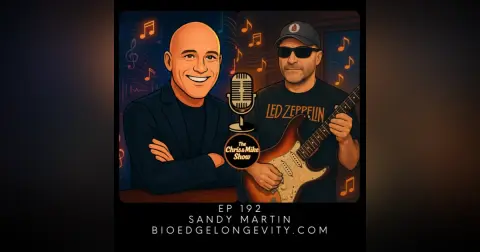
Join us as Sandy Martin shares her journey through biohacking, the importance of understanding your body's signals, and practical strategies for longevity and health optimization. Discover how to decode your biological systems and take control of your health.
Learn more about Sandy at her website below.
https://www.bioedgelongevity.com
Drop by our website below and drop us a review.
Unknown Speaker (0:07): Speaking of which, welcome YouTube and Twitchers. Welcome. Welcome back, Twitchers. I don't know what happened last week, but I had to reconnect us. It was broken.
Unknown Speaker (0:18): It's the Internet. It's the ghost in the machine. That's Sandy Martin. I don't know how it lays out over here, Sandy Martin. Or she could be
Unknown Speaker (0:33): over there. She's on my left, but she could be up there.
Unknown Speaker (0:56): Hey, boys and girls. It's the Chris and Mike Show. I'm Chris He's Mike, and with us today is Sandy Martin. Just so you know, this show is oh, man. I screwed that up.
Chris (1:06): A portion of this show is brought to you by Riverside FM, the one and only choice for podcast platforms. Remember, we are live on Twitch, YouTube, and our own personal website, chrisandmikeshow.com. So if you happen to just go to our website, you can watch the show live there as well. And then this will drop I believe Mike said this is gonna drop Sunday? Actually, Sunday.
Unknown Speaker (1:24): Yeah. We're right on top of things right now.
Chris (1:26): You're the quickest turnaround show ever, Sandy, so no pressure on
Unknown Speaker (1:30): you at all. Welcome, Sandy. Welcome, Sandy. Having me.
Unknown Speaker (1:34): So we're going on a 30 floor elevator ride from the 1st Floor to the 27th. Give us a you got that amount of time to tell us why you're here, what you're all about, what we're gonna chat about today. One, two, three, go.
Mike (1:44): Well, I think most people who are trying to fix something with their health are getting it all backwards. I think everything starts with what we stop. I think the biohacking industry has been well, it's it's it's something that people it's a dirty word.
Unknown Speaker (2:05): Okay.
Mike (2:06): Hacking might as well be the f word.
Unknown Speaker (2:10): Oh.
Mike (2:11): People are upset at the idea that people would hack, and I started my I started my health business in biohacking. And I did that because I had a brain injury after running Comic Cons. I'm all over the place this morning. I think I got a little nervous because it's live. I didn't realize I was gonna be live.
Unknown Speaker (2:28): Don't be nervous. Oh, don't be Just know everyone knows it's real and not AI.
Chris (2:33): Real, real, raw and irrelevant as I like to That's part
Unknown Speaker (2:37): of our charm is there's
Chris (2:38): a little bit of chaos within structure. Absolutely.
Mike (2:42): And so I'll say that everything you can do to better yourself starts with something you say no to.
Unknown Speaker (2:51): Oh, I like that.
Mike (2:53): And so it's a different concept. And I came to this after a couple of years of presenting exhibitors trying to push products on people, which I thought was a great idea because in my own experience, I was just fumbling through the Internet trying to find stuff. And I thought if I put them all in a room, it would help people figure out what's best for themselves. Give me
Unknown Speaker (3:14): an example of what you're talking about, Sandy. So
Mike (3:17): there are things that we can do. Everybody knows what a vitamin is.
Unknown Speaker (3:22): Yes.
Mike (3:23): We call them supplements now because we've got a wide variety of options that aren't just your typical vitamins and minerals. Right. You could take alpha GPC for a brain boost or you could take omega threes for, you know, fish fish oil for heart health or there are all kinds of things. So we'll call them supplements and that's one category. And the other category would be devices like a red light device or a Oh, I like red light.
Mike (3:50): Yes. Or a pulsed electromagnetic frequency, PEMF device, or a hyperbaric oxygen chamber, or something that would be designed to activate your body on a different kind of a level. A lot of that can be done with exercise. Okay. Yes.
Mike (4:08): A lot of things are, most of what benefits us is free. Bodies have a natural intelligence and our bodies send signals, accurate intelligence reports that tell us when something's off. Okay. And so a problem is a signal that something else needs to change. Usually stopping something harming us is the best place to start, but there's this whole industry of stuff you can buy and there are all these companies trying to push things on people I'm culpable I assemble them in a room in a trade show setting.
Mike (4:46): And so in bringing them all into a room, I'm upsetting my exhibitors at this moment. I'm confusing the marketplace. Put 50 to 100 different companies in a room that are like do this for your health, do that for your health. If you just take the supplement, if you just sit in front of this light, if you just breathe this thing, if you put hydrogen in your water, I mean it goes on and on and on and on and on, people walk out more confused.
Unknown Speaker (5:13): Yes they do.
Mike (5:15): So after two years of that, I realized that I needed to put some order into this. And so I came up with the Edge framework. My second book is called Biological Edge and Edge stands for eliminate, decode, gain and execute. And so I'd love to talk at length about things we can stop and pick your brains about things we can stop so that we can feel better. And then once we reduce some of the noise after maybe getting some fragrances or plastics or heavy metals out of our water, air, etcetera.
Mike (5:50): Yeah. We can feel different and start to understand what's happening with our bodies.
Unknown Speaker (5:56): That's amazing.
Mike (5:58): Don't know about you, but Go ahead. Go ahead. Being over 50, I refuse to accept that I should be tired in the evenings or that my joints should ache. But I think Yeah. This is a normal mentality for people.
Mike (6:13): Once you get to a certain age, those things are normal. Yeah. I just I think I don't expect it.
Chris (6:17): Yeah. So when when I when and you can correct me, but Mike and I have had this conversation before, and I'm sure you feel the same way. When when we were kids, when we were at that 12 year old mark, you know, whatever, everybody, when they hit 40, had the Over the Hill party, right, in black balloons and shit. Like, you had you had ten years left. Then you hit 50 And then you leave, you move from the house, you move into the retirement community, you're dead within ten years.
Unknown Speaker (6:40): Yeah. And you and you could see you could see when they turn 40, all of sudden,
Unknown Speaker (6:44): their hair turns gray. And then when they're 50,
Chris (6:46): they're in walkers and shit. It's it's crazy. Now I'm I'm a little different in the sense that that I'm twenty one years sober, but when I got sober twenty one years ago, my entire addiction turned to fitness. So I'm that guy when I was 53 years old. I I ran a mile in under six minutes.
Chris (7:01): I I could run a half marathon an hour and forty eight minutes, you know, 8% body fat and, you know, doing 75 hard twice, and I I stretch my foot. So that kinda knocked me off for little while, but I'm still I still work out, still do everything I've been doing. But so nobody's ever guessed that I'm over 50. And then when I tell them I have grandkids, they're like, you're too young to have grandkids. And I was like, well, you know, actually, my daughter had her first child when I was 50.
Chris (7:26): So she was 25, which my wife and I got married at 20 and 25. So that's kind of you know, we started young. So people are surprised that we're as old as we are, but it's because of the way we live. Like, we don't drink. We don't smoke.
Chris (7:45): We're very clean. We eat very clean. I mean, we don't eat shit. We every now and then eat shit because, you know, you just do. But on a whole, it's like, my my diet is eggs in the morning.
Chris (7:54): I have some type of chicken and rice for lunch. Mhmm. And then I have healthy snacks, apples and nuts through the day and then whatever we have at night. But I don't we don't go to fast food. We don't eat fried food.
Chris (8:06): You know, we air fry fish and stuff like that. But I think it's all kind of geared towards how you live too. And what you put in is what you get out, right? So And I what still you
Mike (8:16): take out matters too. You took out the alcohol.
Chris (8:20): Oh, yeah. Yeah. I've Bro, I've Yeah, I come across people that are my age, and it's like, Holy shit. You look like you're 75. Oh, for sure.
Unknown Speaker (8:30): Know? I don't Especially
Unknown Speaker (8:31): know if they drink every day.
Chris (8:32): Right. And smoke. Like Sean Penn, prime example, that dude smokes and drinks like nobody's business. We're about the same age. And Sean Penn looks like he's 80 years old.
Chris (8:42): Just I saw an interview with him after after the movie, Every Other Battle, whatever, which is great movie, but it blew my mind how how how old he is and just how old he looks.
Unknown Speaker (8:53): Mhmm.
Chris (8:54): Just mind boggling.
Unknown Speaker (8:56): Well, the other thing is stress. Look at that famous picture of Bill Clinton and Sammy Hagar next to each other.
Unknown Speaker (9:01): Oh, Oh, they're like a year apart.
Speaker 0 (9:04): Oh, it's terrible. Oh, it's fantastic. They're like a year apart, and Bill Clinton looks like he's about 97, and Sammy looks like he's about 57. Oh. And I think they're 70 and 71 in the photos.
Mike (9:17): Oh, wow. Well, the presidency will age you.
Speaker 0 (9:21): Well, that's why I bring that up because stress is a even the underlying stress of just the everyday going to work and the grind and people don't realize that they're stressed subliminally almost. You know? It's just it's there, and they don't realize it because I have to be here. I have to be there. I have to and they never stop to take ten seconds for themselves either.
Unknown Speaker (9:44): Well, I agree
Speaker 0 (9:45): with everything Chris said. Nutrition is so important, and it's so overlooked. And we've had people like yourself who have had their own take on, you know, longevity and how to remain younger longer, but all the things that you brought up are pretty similar to the things that they brought up as
Mike (10:04): well. Mhmm. I was taking my mom to hyperbaric oxygen therapy after she had a stroke. It's not that I don't think we should do these advanced therapies because I think they're very helpful when when called for. And we got her better in four weeks with that But on the way there, she said, Sandy, you know stress can kill you.
Mike (10:26): I was like, yeah, I know mom. She goes, no, I mean it. Stress can kill you. I said, Yeah, I get it. She goes, No, I'm serious.
Mike (10:37): Stress can kill you. And I said, Yes mom, it can cause a heart attack or stroke. And she said, Oh, I wish I'd known.
Unknown Speaker (10:46): Aw.
Unknown Speaker (10:48): She didn't know.
Unknown Speaker (10:52): Oh, so she was making the statement like she was, Did you know? Was trying to For say, her Did herself. You I get it. Okay. Okay.
Unknown Speaker (10:57): Yeah. Interesting.
Mike (10:59): And so once she got better, and I think maybe brain injuries are good for the women in my family, we can go into how I had a brain injury too. But following her recovery Yeah. She stopped hating my dad. Oh. So that's lovely.
Mike (11:16): Oh, absolutely. Number I think I married 1960 So it was a long time to be agitated every day of your life.
Unknown Speaker (11:27): Yeah. And
Mike (11:29): they go grocery shopping together. Like, that's the last thing anybody wants to do with my dad. He looks at every label, every price. How much sugar? How much salt?
Mike (11:39): What does this cost? He's really annoying. And she's like, Whatever.
Unknown Speaker (11:45): Whatever. Okay. So what was your mom's brain injury?
Mike (11:50): She had a stroke in her left Okay. Okay. And I had a PEMF device that I was keeping there for a while to help my dad with his osteoporosis.
Unknown Speaker (12:00): Okay.
Mike (12:00): And she felt a little dizzy one day and was like, oh, I guess I'll sit on this thing. And so she did a session on it, but her dizziness didn't clear up. By the next day, her speech started to slur. Oh. And we think that if she had not sat on that device when it first happened, she might have had, she could have had locked in syndrome.
Mike (12:22): That's what you can have when you have a stroke in your left pons. It could have been really, really bad. But there was nothing they could do for it either because she spent twenty four hours having a stroke before she realized it.
Unknown Speaker (12:36): Oh, God. Yeah. Wow.
Mike (12:39): Made it to the hospital. And then they did the CT with contrast and all the things that they do. She'd had an MRI a year prior. Her doctor said, There's nothing anatomically wrong with your brain. We knew there was something off.
Mike (12:52): But the doctors don't do enough testing to tell us what's actually wrong with us. It's not their fault. The insurance company is governing what they're allowed to do.
Unknown Speaker (13:01): 100%.
Unknown Speaker (13:02): Well, that
Chris (13:03): may just and they're just practicing medicine too. People think doctors, like, they should know everything, but they're practitioners.
Unknown Speaker (13:09): Yeah. Exactly. Doctors, lawyers. It's the practice of medicine, the practice of law. That leaves them open to
Unknown Speaker (13:17): Yeah.
Unknown Speaker (13:17): Make mistakes.
Chris (13:18): Yeah. Right. Nobody knows everything unless you watch The Pit and know Wiley's character. He knows it all. Every He single the script.
Chris (13:26): Every single moment of the day. You know? And he started remember when he was an intern in Chicago at I forget what the hospital. You know? And and now he's, like, head of Pittsburgh.
Chris (13:34): It's like he moved further to the East Coast and got completely burned out. It's good to be
Unknown Speaker (13:39): the star.
Unknown Speaker (13:40): That's Yeah. Least you caught that late.
Chris (13:45): At least you caught that Sandy. Some people don't some people don't catch my random conversations, like, about the bungees.
Unknown Speaker (13:49): Sometimes he catches you so by surprise. I give him credit for that.
Mike (13:55): Yeah. No. It's all good. She she just decided that nothing was worth getting worked up about anymore. Now a year later, she's not as good at letting shit go.
Unknown Speaker (14:10): But So, you know,
Speaker 0 (14:11): that's something you have to practice every day because Yeah. Not only is it the letting things go, but it's the underlying negativity that will also kill you. Yeah. I had to learn that lesson the hard way because I became negative about everything, and I looked around, and there was nobody left. You know?
Unknown Speaker (14:31): I was sitting there by myself thinking, well, shit. I guess I'm the problem. Right?
Mike (14:35): That's awfully insightful.
Unknown Speaker (14:37): What not
Unknown Speaker (14:38): a lot
Speaker 0 (14:38): of people. Choice. At that point, Sandy, I had no other choice because, seriously, there was one person left in my life that I really could count on, and I'm I'm talking to him now. You know? We were starting to put another band together.
Unknown Speaker (14:54): Yeah.
Speaker 0 (14:55): It it just was the lowest point in my life. I've seen other people at that point, and you just feel for him because you know if you don't change the way you think and realize that every day is a new beginning, you're never gonna move forward. So many people live in their past or worse yet carry around that negativity. Everything is somebody else's fault. They screwed me.
Speaker 0 (15:16): The government screwed me. My family screwed me. Well, what are you gonna do about it? You know? I was smart enough to look in the mirror and say, I guess I'm the problem, and I'm going to become a positive person.
Speaker 0 (15:27): I'm gonna try to be nice to everybody even if they disrespect me. I'm not gonna let them have any power over me. I'm not gonna be friends with them.
Unknown Speaker (15:35): But
Unknown Speaker (15:35): Right. I'm going to be kind as much as I can. I'm following his shirt. Right?
Mike (15:40): Yeah. Well, I was a raging bitch until I got mold in my brain.
Unknown Speaker (15:45): Oh, shit. I say I read a little bit about that. You spent like was almost a $100,100
Unknown Speaker (15:49): that, for sure.
Unknown Speaker (15:50): Yeah. Well, I wanna preface it, though. She spent almost a $100,000 trying to figure out what was wrong.
Unknown Speaker (15:55): Yeah.
Chris (15:55): And then you realized it was mold.
Mike (15:57): Right. Getting better cost nearly nothing. And part of what I spent was $27,000 on a hyperbaric oxygen chamber because they prescribed $20,000 in treatment. And I thought, well, I'll spend the extra 7, have it at home and then other people can benefit.
Unknown Speaker (16:15): Sure.
Unknown Speaker (16:16): Yeah. I own the company.
Unknown Speaker (16:17): I have it.
Mike (16:18): My ex husband has it.
Unknown Speaker (16:19): Wow. Badster. He got in a divorce?
Mike (16:22): It was too big. He'll let me take it back anytime I want, but it's
Unknown Speaker (16:25): I was say I got a truck. You know?
Mike (16:27): The thing is so heavy and
Unknown Speaker (16:29): so weighs 4,000 pounds?
Mike (16:31): I think it might be 2,000, but it's a lot. Wow.
Unknown Speaker (16:33): That's still crazy.
Mike (16:35): It it we had to keep it at the warehouse, not actually at home, because we couldn't get it into the home. He has it in one of his office spaces. We were running Comic Cons together.
Unknown Speaker (16:47): Oh, gotcha.
Mike (16:47): Gotcha. A really stressful kind of an event to run. 50,000 people in a weekend.
Unknown Speaker (16:55): Comic Con.
Mike (16:56): Yeah. So ours was Galaxy Con.
Chris (16:59): Okay. So what's Galaxy Con? So I don't know. So what's Galaxy Con?
Mike (17:03): Galaxy Con is like a Comic Con. Okay. But whereas most Comic Cons are It's
Unknown Speaker (17:10): dress up and
Mike (17:11): It's the same as that. But they have limited hours and limited content. This is from 10AM to 2AM, something happening in 10 different rooms at the same time, 50,000 It's people running a major undertaking. Right on. We were doing fantasy cosplay wrestling and celebrities on stage and Wow.
Mike (17:36): Kids teaching other kids how to create costumes or play games or I mean, just It's really a lot of fun. But that's his that's his baby and I helped him with it for a long time. And I really felt like the pooper scooper of the business. Like, felt like the guy that goes behind the horse in the parade and just kinda just scoops up the poop. And
Unknown Speaker (17:57): I Gotcha.
Mike (17:58): I felt, like, really stressed and responsible for everything that had to take place. Okay. I was a raging bitch.
Unknown Speaker (18:07): Okay. And
Mike (18:08): then I was COVID hit. We had to convert the whole thing. Had to refund $400 in tickets. Oh. We had to convert it all virtual.
Mike (18:17): Talk about stress. So I built an e commerce system to make it work. Then in the next month, I couldn't run reports on the system I built. And I didn't know what happened. But I suddenly couldn't function.
Mike (18:32): Weird. Everything about thinking was off.
Unknown Speaker (18:38): Out of nowhere. Thinking
Unknown Speaker (18:39): out of nowhere. Weird. So I thought, Oh, I fried a circuit. I've been working so hard. It just finally blew it.
Mike (18:49): Like my brain is done. Let me take some time off. Took a day off, a couple days off, took two weeks off. Got worse.
Unknown Speaker (18:57): You probably should oh, really? You time off got worse? I got worse.
Unknown Speaker (19:01): That's strange. Because I wasn't burnt out. I had mold in my brain. Oh. Oh, I didn't know what was going on.
Mike (19:09): I didn't understand. I had painted an area that was wet and I didn't know that it had been, it must have been wet for decades. Like it was just a danger zone, but mold exists behind the walls, it can go through the air and can be in there. And someone who's an expert on it explained to me that it was probably because I was painting in the area.
Unknown Speaker (19:32): Oh God.
Mike (19:33): That those paint fumes took it directly into my brain through my optic nerve or my Wow.
Chris (19:39): Crazy.
Mike (19:40): And so I went to a screeching halt.
Unknown Speaker (19:43): Okay. And
Mike (19:44): then I believe I have no basis for knowing. No ability. There's no test that will tell you, but I believe that the inflammation that the mold traveled because it eats, like it feeds off of us whether we are alive or dead. It doesn't care And either so it went to the most active part of my brain.
Unknown Speaker (20:07): Wow.
Mike (20:08): Everything I knew to be me got real quiet. And I couldn't make judgments. I couldn't make decisions. Couldn't decide what goes in that field in that spreadsheet. Right?
Mike (20:21): Like it wasn't just that I couldn't decide what car to buy, which was also a thing. I had my brother pick a car for me because I had to trade in a lease and get something new.
Unknown Speaker (20:29): Damn.
Mike (20:30): But I couldn't make the decision on my own. And so I picked somebody who I trusted and let him decide.
Unknown Speaker (20:36): Yeah.
Mike (20:38): And then I spent five months trying to figure out what was wrong with me before I stumbled on Dave Asprey's book and he described his situation with mold. I got tested for that and sure enough, I had the mold, and I was able to start to heal.
Unknown Speaker (20:53): What was the time frame between you painting and this first day that you noticed?
Mike (20:59): Two weeks.
Unknown Speaker (21:00): Wow. Okay.
Unknown Speaker (21:02): So how
Unknown Speaker (21:02): So I was like 15. By two weeks, I was toast.
Unknown Speaker (21:07): I'm curious to know how how Damn.
Unknown Speaker (21:09): So you're breathing in. Right? You're breathing in the mold. Mhmm.
Chris (21:12): And then it just decides to find a place to your brain?
Mike (21:15): So I because so most people who have a moldy environment, they are they they gradually get sick. Right. It's it's small doses. Yeah. They get it over time.
Mike (21:27): It builds up.
Unknown Speaker (21:28): But you disturbed it by painting it. Right?
Mike (21:31): Well, I the paint fumes themselves are were a carrier.
Unknown Speaker (21:36): They picked it up and Mhmm. Stuck it right in your nose, and it went right to your brain Yes.
Mike (21:42): Also my optic nerve. So I don't know if you know, but your eyeballs are actually part of your brain.
Unknown Speaker (21:47): Okay. Really? I guess I did not.
Chris (21:49): No. I did not know that.
Mike (21:50): Yep. They're directly attached to the brain.
Unknown Speaker (21:53): That's why we do this. There's my one thing I learned new to do. That's fantastic.
Mike (21:57): Yeah. And so and they found it on my optic nerve. So that's one of the ways they test for it. Yeah. And so I just, I went to a neurologist.
Mike (22:10): I figured out I was sick mid October. By mid November, was at a neurologist office, had a brain scan. They performed the And brain scan so I was diagnosed, misdiagnosed with a TBI. Okay. He had done an intake.
Mike (22:27): I'd hit my head when I was 10. He was like, It's come back to haunt you. I see it all the time. I'm like,
Unknown Speaker (22:33): No. And old were you when this started happening?
Unknown Speaker (22:36): I was 45.
Chris (22:37): His perspective? Okay. So this so thirty five years later, he's trying to say this came back?
Unknown Speaker (22:42): Uh-huh. Wow. Practicing. Practitioners.
Unknown Speaker (22:46): Yes.
Mike (22:48): And so, you know, I refused to accept that diagnosis. I refused to take the drug he prescribed.
Unknown Speaker (22:56): Good job.
Mike (22:58): And I set out to figure this out on my own. And it was slow because my brain wasn't processing. I was I still had my intellect.
Unknown Speaker (23:07): Okay.
Mike (23:07): But but my ability to discern was off. So I could read and take notes. Okay. And review them. Yeah.
Mike (23:17): But it didn't flow like we understand to be absorbed and digested and integrated.
Unknown Speaker (23:24): So it kinda got stuck. It got stuck from the eyes to the translation. Yeah. It just kind of I'm reading it all. I'm seeing it all.
Unknown Speaker (23:32): I think I'm grasping the concept, but then processing Not processing. Just kinda lays there. Yep. That's Wow, that's a trip.
Unknown Speaker (23:40): That would get so frustrating.
Unknown Speaker (23:44): That was It is driving very well.
Unknown Speaker (23:46): Oh, thank you. That's a trip. That's
Unknown Speaker (23:48): just Wow.
Chris (23:49): I can't imagine that. That would be frustrating on its own.
Unknown Speaker (23:54): And so now I thought I just need to optimize my brain. -Okay. -So it was extremely frustrating.
Unknown Speaker (23:58): It's like when you're sitting there waiting for a file to upload on your computer and it just never ends.
Mike (24:03): I called it buffering.
Unknown Speaker (24:05): That's -Right on. -Yeah.
Unknown Speaker (24:06): That's what he just described. It's There's no processing. It never ends.
Unknown Speaker (24:10): Right. Right.
Chris (24:12): Okay. Interesting. Would be horribly Yes.
Mike (24:18): I I went on a wild goose chase to figure out what was wrong with me.
Speaker 0 (24:23): And The fact you didn't go crazy is a testament to your willpower.
Unknown Speaker (24:27): Thank you.
Unknown Speaker (24:28): It really is.
Mike (24:29): I was really, really dedicated to two ideas. One, it wasn't me. Because my first symptom was depression.
Unknown Speaker (24:42): Okay.
Unknown Speaker (24:42): I felt depressed. Anybody I
Unknown Speaker (24:46): brain see
Mike (24:46): wants to close the loop. Right. It doesn't like uncertainties. So I had a sensation in my emotional and physical body that said, and my brain said, Oh, we've been here before. That's depression.
Mike (24:59): And I was like, Yeah, I don't think so. And so I had to argue with my brain quite a bit. And then I really just wouldn't accept that at 45, that was the end of me.
Unknown Speaker (25:15): Yeah. That's good. Came on I just
Unknown Speaker (25:19): am sometimes.
Unknown Speaker (25:21): That's good
Unknown Speaker (25:21): to know. Yeah.
Unknown Speaker (25:22): Me too.
Unknown Speaker (25:23): I think we all have that in common.
Mike (25:25): Yeah. So I'm no longer a raging bitch. Might be an occasional pain in the ass, but I'm no longer a raging bitch.
Chris (25:34): How long how long did it take for the is the mold gone? Does it just what you did made it just disappear?
Mike (25:41): It started to go down. I had two tests, and it was lessened the second time I took a test. But I'm going based on how I feel. And I'm almost just afraid to know. Like, if I still have mold, but I feel fine and I'm doing all the right things, then maybe there's, like, traumatic thing that makes me
Unknown Speaker (26:02): Yep. Get that.
Unknown Speaker (26:04): You don't want to be a trigger. Right? No.
Unknown Speaker (26:06): Right.
Unknown Speaker (26:06): Yeah. Creeping back Yeah.
Chris (26:08): It could trigger you thinking, Oh gosh, should I go again? And then you're automatically Your mind's gonna shift that way because why wouldn't it? It's human nature, right? Like, Oh shit. Now I gotta do this again.
Chris (26:16): Here we go again.
Unknown Speaker (26:17): Right.
Unknown Speaker (26:19): That's crazy.
Mike (26:21): Have you guys ever had any mysterious illnesses?
Unknown Speaker (26:25): I don't I don't know. Don't know.
Speaker 0 (26:27): I I don't know. The more I talk to people like yourself who have, I know you didn't have TBI, but I've taken some pretty serious shots to the head that I never really gave any credence to until I started learning how serious even one of those is. You know? And then I think back to some of the impulsiveness in my life and things that I can't explain. All those things make sense now that I understand that.
Unknown Speaker (26:54): Right?
Unknown Speaker (26:54): Yeah.
Speaker 0 (26:55): Yeah. You know, I don't beat myself up so bad for some of the what I considered stupid decisions at the time, you know, or why did you do that that really made my life take a turn, a a hard left turn or a hard right turn that I didn't anticipate just because I made one decision or another. I give myself credit for that those moments now. You know? And then you don't beat yourself up and be so negative about not being smarter.
Speaker 0 (27:23): That has nothing to do with it. You know? You just you think differently than other people. But I think those I think that same curse was also a gift in that I've never been able to explain how I can play an instrument or how I understand sound and how something should sound good. And I'd look at somebody else who thinks that something sounds good, and I wonder, how do you not know that that sounds bad?
Speaker 0 (27:50): Right? So I think that there was a gift that kinda came along with that curse as well.
Mike (27:56): Yeah. Yeah, that could be. Because if they It would be really interesting to see inside of your brain and see the balance between the default mode network and the frontal lobe.
Unknown Speaker (28:12): I should
Mike (28:14): Default mode network is where that creativity happens.
Speaker 0 (28:16): I should definitely go, you know, again to a neurologist. I went after I was in a bad car accident and I was more concerned about what happened in the accident than Sure. You know, I wasn't thinking about anything we're talking about. No. I've learned that probably in the last five to six years, you know, just through listening to podcasts myself with doctors who understand this.
Mike (28:39): I really love doctor Daniel Amen and what he does with SPECT scans. It's really fascinating to see personality show in which regions of the brain are quiet or active. Really fascinates me.
Unknown Speaker (28:55): Yeah, I'm with you. I would definitely like to see what that looks like in my case.
Chris (29:02): Yeah, so I pulled up one of your pages, Sandy, the 15 biological systems.
Unknown Speaker (29:07): Yeah. So
Chris (29:09): let's go ahead. I want you to kind of elaborate on these things without spending, you know, too much time on each one because obviously there's 15 of them. But I think what you're sharing with us is fascinating, number one. And so as I scroll to this, I stop because this just is fascinating to me. So what you're doing is kind of addressing all these 15 biological systems to have better longevity and healthier life?
Mike (29:36): What I hope to do by outlining the systems, I pulled together using AI, like I don't have the education or experience to be able to explain to you how the detoxification system of the body works.
Unknown Speaker (29:51): Okay.
Mike (29:52): I know a little bit about the nervous system, little bit about breath and circulation, but not to the degree to which we can dive in on the website.
Unknown Speaker (30:01): Okay, okay.
Mike (30:02): But my goal with identifying the systems was to identify how they interrelate and what kinds of activities can enhance multiple systems. Okay. And so, you know, if you reduce sugar in your diet, how many systems is affected? If you increase your hydration, you know, how far does that go? Okay.
Mike (30:29): Considering that it's your emotional system and your stress are two different things how our hormones coordinate the functioning of ourselves is not something I'm equipped to describe. But what I am interested in is getting that people to optimizing any of these you can go through and look at the edge framework in each one is that everything starts with what we stop and then we can decode what's happening in our bodies and only then do I believe we should start adding. I really love the idea of hyperbaric therapy for a traumatic brain injury. I think it's wonderful. But when I was misdiagnosed with a TBI and I put HBOT on my brain, it gave me headaches because mold fights back.
Unknown Speaker (31:26): Oh, It
Unknown Speaker (31:28): gave me headaches.
Unknown Speaker (31:29): Yay, mold. Waste It of money keeps on giving. Yeah.
Mike (31:33): Right. It helped after I got the mold out, but not before. And so I also have, there's a link at the top for Decoder, and I've built an AI chat based on these systems and this information. So that if you type in something, I don't know, you might want to do this. Click on Decoder.
Unknown Speaker (31:54): Let's do our live boys and girls. Yeah. Did share?
Unknown Speaker (31:58): Click on it. Clarity.
Chris (31:59): I wanna make sure it's shared because okay. Cool. Sometimes when I click something, it won't share it. We'll let you know because
Unknown Speaker (32:06): we won't be able to
Chris (32:07): see it. You want me to click on get clarity?
Unknown Speaker (32:09): Uh-huh.
Unknown Speaker (32:09): Okay.
Unknown Speaker (32:11): So just
Unknown Speaker (32:11): type in something? All right. Are you experiencing?
Mike (32:13): Okay. Anything you're feeling and
Chris (32:17): I'm gonna do this for someone I know who's over the age of 50. And it has to do with with, the menopause thing.
Unknown Speaker (32:28): Okay.
Unknown Speaker (32:29): Why you gotta give away all my secrets?
Unknown Speaker (32:31): Let's give
Unknown Speaker (32:33): let's let's give. That was personal, dude.
Chris (32:35): I'm sorry. So hip pain and menopause together, there's likely a lot going on. Where exactly does the pain sit deep in the joint, along the outer hip, or more lower back area? I'm just gonna guess. I'm gonna say deep.
Chris (32:49): Whoops. This is fascinating, Sandy.
Unknown Speaker (32:55): Yeah, that's really cool.
Mike (32:57): This is designed to give you So after three responses, it'll give you a summary. So I want you
Chris (33:03): get So joint one the connection to the lower back is noted. How long has it been present and did it come on gradually or did something specific seem to trigger it? Came on gradually with That was
Unknown Speaker (33:18): my choice as well.
Unknown Speaker (33:19): Good choice.
Unknown Speaker (33:20): Yep.
Unknown Speaker (33:26): So
Mike (33:26): those That's of going to start a summary and identifying the systems of the body that are related now that you've given it three responses, and it will continue to ask you questions.
Chris (33:37): Okay.
Mike (33:38): What this presumes is that your body is accurately sending intelligence reports about what's happening. Oh, okay. And that pain is an appropriate signal, not a problem. If you're having hip pain, your body's telling you to pay attention to what we don't generally know. Right.
Mike (34:02): Interesting that you bring up menopause, I have a very contrarian view about menopause.
Unknown Speaker (34:07): Okay.
Mike (34:07): I believe that, I believe it's not a disease. It's not a disorder. Yep. But we're treated as if it is because our health system can't give a drug unless it diagnoses a problem.
Chris (34:24): Right.
Mike (34:24): And so in order to sell us hormones, they have to label us as problemed in order to give us the hormones to make it better. I'm not anti hormone therapy. Right. But I do believe it's like taking an Advil for pain. I think it's just symptom treatment.
Chris (34:41): Even if the hormones taking the hormones actually have had a benefit in this person?
Mike (34:47): Yeah, so does Takes away pain.
Unknown Speaker (34:50): Oh, good point. Right? Good point.
Mike (34:52): So we'll reduce a fever. Well, but but what are we addressing and what's going on? Gotcha. Women seem to me to be designed by nature to have these hormones fall off. Okay.
Mike (35:04): And over a certain age, once we're postmenopausal, they don't encourage us to keep taking the hormones. We can, some do. Right. But it's this painful mid period that's being diagnosed and treated. And I think that a lot of that pain and suffering is coming from high inflammation.
Mike (35:27): I think that estrogen levels that we've had so that we could, I don't know, maybe birth babies through a famine. Maybe that protective layer makes us less likely to feel pain.
Unknown Speaker (35:40): Okay.
Mike (35:41): And then when those hormones fall away, all of the damage we've done to ourselves through stress and diet and drinking and whatever else we do, maybe we suddenly just feel the damage we've been doing all along.
Unknown Speaker (35:56): Right.
Mike (35:57): And so I would encourage anyone my age, younger, to say, okay, I'm having a hot flash. What did I eat today? Did I get stressed out? What's going on? Is there
Unknown Speaker (36:12): True journal.
Mike (36:13): Yeah. Okay. And then is there something I can do to minimize the symptoms beyond just going straight to hormones?
Chris (36:24): Interesting. And So that's basically what you did with your situation, right? Because you had all the doctor, doctor, doctor, then you decided, know what? Stop. Instead of doing that, let's find a natural way to to resolve this issue without pumping myself full of the drugs and the chemicals that we all know in the pharmaceutical company is a trillion dollar industry a year because America is, let's make sure you're unhealthy so we can generate all this income, whereas opposed to all the other countries in the world, we're not gonna opposite.
Speaker 0 (36:56): Thing that she just said that we hear all the time is inflammation. What is most inflammation caused by? Your diet.
Unknown Speaker (37:03): Yeah. Yeah. Oh, yeah.
Mike (37:05): And what's in the water and what's in the air. And, you know, it's not just the diet, but I mean, we do eat Yes, every
Unknown Speaker (37:12): we do eat. We do eat food every We have to. Have to.
Mike (37:15): So the I made reference earlier to mold not caring if you are alive or dead. When I finally figured out it was mold and my first doctor who diagnosed it, she put me on a drug called Nystatin and I took it because by that point I was five months in, was desperate. Was gonna do whatever anybody said to feel better. Four days in, I just kept imagining myself drowning myself in my tub. And I did not have a history of suicidal thoughts.
Mike (37:53): And the fifth day, I went to my cabinet and I took the pill bottle out and I went, Oh, you're new. But that day before, it was so bad. I'd had a fight with my ex husband. I couldn't get anyone to help me. I had to call his mother to get any help at all, like after twelve hours of really like out of my mind, why am thinking these thoughts And in my when recognized the drug as what was new in my environment-
Unknown Speaker (38:28): Yeah.
Mike (38:29): I didn't take it. I called my doctor and I said, Hey, I can't take this. And she said, I told you you'd need mental health help to get through this process. And I said, That's not how this works.
Unknown Speaker (38:41): -No.
Mike (38:41): -You don't give me a drug that gives me suicidal ideation, and then I just go talk to somebody about it so I feel better. That's not how we do this. -And -No, that's that was not my your real turning point. That was when I had to take matters into my own hands because I couldn't trust the doctors at all anymore. And I did go to another doctor
Unknown Speaker (39:01): who charged
Mike (39:02): 13,000 upfront. Because I was desperate, desperate. But he had the protocol I had researched and he was gonna be the one who could help me. And his best advice was to not acknowledge my symptoms, which was great advice.
Unknown Speaker (39:22): Yeah. Yeah.
Mike (39:23): It changed my life. Yeah. But he also didn't do anything for me. And so when all he had
Chris (39:32): So give me $13, and I'm going tell you, ignore your symptoms. Have a nice day, Sandy. Is that check or cash?
Unknown Speaker (39:39): Because I'll take you there. I
Unknown Speaker (39:40): need that job. -Yeah. -I'd be good at that.
Mike (39:44): Gave me a genetic test that he couldn't interpret.
Unknown Speaker (39:49): Okay.
Unknown Speaker (39:50): -:
Unknown Speaker (39:50): Yeah.
Unknown Speaker (39:51): -:
Unknown Speaker (39:51): Okay.
Unknown Speaker (39:52): -:
Unknown Speaker (39:52): And so that -: Wow.
Unknown Speaker (39:55): -:
Unknown Speaker (39:55): I could probably do that.
Mike (39:56): It's really out of desperation that I've come up with, know, had to really parse the things. Did I get better? How did I get sick? How did I get better? Which things worked?
Mike (40:11): Which things were a waste of money?
Unknown Speaker (40:15): And now
Mike (40:15): I like to share the story because the biggest aggravation people have with the longevity space is that they say it's for tech billionaires. Well, I'm not that. And And
Unknown Speaker (40:25): it shouldn't be. It shouldn't be for billionaires.
Unknown Speaker (40:29): And I had I had some money to spend on my brain, but that money didn't even work. Yeah. It didn't get me where I am.
Chris (40:37): And it shouldn't it shouldn't matter what your what your financial what it was what's the word? What your financial availability is to get the help you need
Unknown Speaker (40:46): Yeah.
Chris (40:46): To live a a a better, healthier life.
Unknown Speaker (40:49): Right.
Chris (40:50): It's just I mean, I know that's what is that? Socialism? Medicare medical like, Canada. But I I just that's mind boggling. There's few thousand dollars for nothing.
Chris (41:01): Jeez.
Mike (41:02): A bunch of tests he didn't know how to interpret.
Chris (41:04): Jeez. Let's well, let's smear him. Let's do a smear campaign.
Speaker 0 (41:09): That is terrible. It really is. Ridiculous. And you said it earlier, Sandy. We're not we're not discounting modern medicine because modern medicine has its place.
Speaker 0 (41:19): And if you're dying and you need a blood transfusion, you should go get a blood transfusion so you don't die. If you need whatever to stay alive, my dad's on medicine that keeps his heart in rhythm. Right? There's no reason he shouldn't take that because he's a naturalist. There's a version of lunacy on both ends.
Speaker 0 (41:38): Right? Uh-huh. But I think it's important for people to understand, like you said, if you're going to your doctor and you are not getting any better, there's no reason to continue to go to that doctor. Right? You should go either get a second opinion or start doing your I mean, all the you have the Internet at your disposal.
Speaker 0 (41:56): You have most of the answers you need. You just have to ask the right questions.
Chris (42:01): Right. But at the same time, you don't is self diagnosing always the best approach?
Unknown Speaker (42:07): No. That's why I said, I think you and she did it. She went and got a second, a third, a fourth, a fifth opinion. But Right. Your situation was so unique, and there's a lot of people who end up in these unique situations where you're being attacked by something that is not normal on a day to day basis for most people.
Mike (42:26): Well, let's talk about what I would have been diagnosed with if I hadn't kept fighting. Yeah. Chronic fatigue syndrome.
Unknown Speaker (42:32): Right.
Mike (42:32): Autoimmune condition.
Unknown Speaker (42:34): Right.
Mike (42:34): You know, something because the what it causes is an inflammatory response. They call it chronic inflammatory response syndrome.
Unknown Speaker (42:43): Yeah.
Mike (42:43): That's how did in 2017 I went to my primary I got a big blood panel done and I said, can we do C reactive protein? I wanna check my inflammation levels. And he said, no, I don't test for that. I was like, why not? And he goes, well, can't do anything about inflammation so I don't test for it.
Mike (43:05): But we can do something about inflammation. I'm proof that And we that's what so much of the industry is missing. They're missing the tools and the wherewithal and the motivation to reduce inflammation. We don't even have a really great way to measure it. C reactive protein, what isn't the best measurement for it?
Mike (43:25): There are other tests that are more specialized that you frankly just can't get from your regular doctor. Interleukin six, interleukin nine, like, you can't get these from your doctor. The insurance companies won't let them order those tests for you. They don't want you to know.
Chris (43:43): No, of course not. Kind of like you have the ability to make What the big rage? Is diabetes to make diabetes medicine very They do want. Right? And they don't.
Chris (43:53): It's like, Let's overcharge arm and leg. But you can get Viagra for $5 for a month's supply. So let's make sure you can have sex.
Unknown Speaker (44:01): How do you know that?
Unknown Speaker (44:02): Because it's everywhere.
Unknown Speaker (44:04): It's everywhere. You have a commercial every two seconds on TV.
Chris (44:08): No. No. But it pops up on everything. It's, you know, anything you have, like the fun thing about this show, right, because my phone's in front of me. Mike's phones show Mike's Mike's phone is in front of him.
Chris (44:20): We all know that that the phones listen to everything. Because as soon as we get done with one of these recordings, all of sudden, I get these different algorithm. My my algorithms online are so out of whack.
Unknown Speaker (44:30): Podcast has definitely screwed up.
Unknown Speaker (44:33): You're gonna get a bunch of menopause ads next.
Unknown Speaker (44:36): Oh, I don't doubt that.
Unknown Speaker (44:37): We had just a couple
Speaker 0 (44:38): It's funny he brings a sorry to interrupt you. It's funny he brings that up because I was just thinking about that two or three days ago as I'm sitting at break at work and scrolling through my Facebook. I'm like, what are all these weird oh, these are all podcast people. They were all ads for people who had been on here. You know, the Kava guy and Mhmm.
Chris (44:56): Yep. Yeah. I get Kava emails now. We had this couple on that they're they're they're, in the the the active adult or not the active adult, the, the, swinger lifestyle called the impulsive duo. All of a sudden, I started getting things for that.
Unknown Speaker (45:08): Yep. Them too. We've had
Chris (45:10): we've had musicians on, and they started getting things for for music and recording. We have producers on, directors on, actors on, talent agents on. It's it's this broad spectrum of stuff because we started this thing originally just based on recovery because I'm twenty one years sober. Mike's about fifteen, eighteen years clean. So it was the foundation was that music.
Chris (45:28): And then we had this stupid little innuendo bit we were talking for no reason. We had a guest that belled on us, and and it was like, I just, you know, I just want a living, breathing human being. And I was like, you know, maybe we have a zombie. And Mike's like, you can't have a zombie. I don't think that would work.
Chris (45:42): So that little, like, less than sixty second clip blew up, and then all of a sudden, people started knocking down our door to be guests. And what we call it is life resume. So you have this amazing life resume, which is you somehow you prompted to reach out to Mike for you saw something. But and and so based on what I read, I'm like, we need to get Sandy on, even though I had that little mix up a couple weeks ago. Are you Sean or are you Sandy?
Chris (46:05): Because this is weird. Because there's I know a guy named Sandy, so that's why it wasn't it wasn't off putting to me. I thought maybe it's the same person.
Speaker 0 (46:13): And right away, we had the same last name and two guests back to back. You guys were so close together and both Yeah.
Chris (46:19): It was weird. Oh, funny. It was weird. It was weird. So but but that's the fun thing about this show.
Chris (46:24): It doesn't matter who you are. And like comedian, we have comedians on, then all a sudden, have a bunch of comedian shows come up in my feed. When we when we finish this thing and, you know, it's gonna be all about bio biometrics and different things, health, and because that's what it does, which is neat. So, you know, it's interesting to see what the phone picks up, you know, days after the show. And then all the things
Unknown Speaker (46:45): that we've learned. Just today, we learned that the optic nerve is part of the brain.
Unknown Speaker (46:50): I It is?
Unknown Speaker (46:51): I had no idea. I had
Chris (46:52): no idea. I had no idea. And the fact that you have that really cool bio edge decoder, I'm I'm gonna share that with a couple people because I think it's fascinating, you know? Thank I mean, I don't I'm I'm pretty damn healthy. My biggest my biggest thing is asthma, and I've had asthma since I was, what, three months old.
Chris (47:08): But I was a product of the environment in Illinois where it's like I had to move where I was gonna be dead in three months. So we decided Arizona because it's hot. They're tired of the cold. Now listening to you, though, obviously I couldn't make a conscious decision when I was three months old, but is asthma really a product of who I am or is it a product of the environment? Know, because Illinois, all that mold, right?
Unknown Speaker (47:32): Cold, very conducive to
Mike (47:34): own kind of mold too.
Unknown Speaker (47:36): Oh, sure. Oh, yeah.
Unknown Speaker (47:37): And so
Unknown Speaker (47:39): And tons of pollen.
Chris (47:40): Uh-huh. Oh, pollen's crazy right now. Arizona's one of the worst states for asthmatics to move to nowadays. There was a point in time where I was allergic to everything in Arizona except horses, dogs, and guinea pigs.
Speaker 0 (47:51): And there was a time in the past where they sent people there who had tuberculosis because it was the perfect arid environment. Right? Right. But what happened is, for lack of a better term, all the assholes moved from the East and West Of Arizona and brought their plants from those states, and they screwed up that desert environment. And now they have what he's describing.
Unknown Speaker (48:13): Yep.
Unknown Speaker (48:14): Yeah.
Chris (48:16): Like, one of my grandsons had allergies to palo verdes, orange trees, and any type of wood because his his dad worked in wood. Like, he he put in wood floors and stuff. So he'd come home from work, and he'd pick up Tripp, and Tripp would break out in hives. I'm like, what's going what's going on? And then they finally get that whole back allergy test for Tripp and realize, oh, yours are all these things that your dad does for a living.
Chris (48:37): So he had to completely change his line of work. And we had to cut down, which I was happy to do, I hated him, five five Palo Verde trees and an orange tree just because those alone were making him chaotic, just making his nose constant. He'd run, eyes water. It was terrible. And he's You know, at the time, he was a year, year and a half old, so he couldn't vocalize anything.
Chris (48:57): He couldn't explain anything. You're just constantly running from allergies.
Mike (49:01): I'm really curious. You said you still have asthma?
Chris (49:04): I do. It's more like, I have an inhaler. Don't remember last time I took it because it's a PRN. It's a PRN thing. I got to the point when because I've worked out so much because of my running, things like that.
Chris (49:18): I I like, when I ran my back to max under six minute miles, I didn't take my inhaler. You know? I got in such really good physical condition, cardio condition wise, before I broke my foot, and I was basically not able to do any cardio for eight months. So I just did upper body core. Even that still helps the the heart cardiovascular because you're still straining and that type of thing.
Chris (49:40): But I've when the pollen's out, like this time of year, I notice it's even though I'm in shape, I notice there's okay. If I don't catch my breath when I first start running, I can't catch my breath. As long as I start with a good breathing pattern, then I'm cool. But if I'm in the midst of something, one of those days where I just and there's days like that, I just can't catch my breath. No matter what I do, I just can't catch my breath when I'm running.
Chris (50:03): So then I gotta slow down, walk it out, start over again.
Mike (50:06): So what I think is really fascinating about all of that is that you have demonstrated the ability to shift your biology from something that people thought you were born with.
Unknown Speaker (50:18): Oh, I didn't thought of I never thought of it that way.
Unknown Speaker (50:22): Cool. Power of
Unknown Speaker (50:23): the mind.
Mike (50:24): Might be difficult. Well, That's it could be the absence of the alcohol. Might
Unknown Speaker (50:30): be Why wasn't drinking when I was three?
Mike (50:33): That's true. But what's in alcohol could be in for the wheat, the barley, the whatever, Could have been in your diet in some way. Could have been there could have been things about it.
Chris (50:46): Interesting.
Mike (50:47): Food sensitivity, a lack of physical vigor, you know, because you aren't running marathons at three, nor should But there are factors that we can shift over time and our bodies completely change over every seven years.
Unknown Speaker (51:06): Sure, right.
Unknown Speaker (51:07): It's like a
Chris (51:07): snake shedding their skin, right?
Mike (51:09): Yep. Yeah, and our gut lining repairs itself every three days. So it's- Really?
Unknown Speaker (51:15): I didn't know that.
Mike (51:16): Yeah, it's all in a different timetable.
Unknown Speaker (51:18): Wow.
Mike (51:19): But we're constantly remaking ourselves.
Unknown Speaker (51:22): That's cool.
Mike (51:22): And that's the piece that I think is brilliant. If you think about the world we live in with AI and how it's gonna change everything, also know its limitations. It's limited to language right now. Yeah. Smart thing it knows
Unknown Speaker (51:39): Yeah.
Mike (51:39): Is only based on what we've been able to put into words.
Chris (51:42): True. And what we yeah. Exactly. What you feed because a year ago, the level of AI was nowhere compared to what it is today.
Unknown Speaker (51:49): But
Unknown Speaker (51:49): our We had a bodies body Yeah. Yeah.
Mike (51:51): Our bodies are working in ways that no one has been able to describe. The capacity inside of us is beyond anything ever
Unknown Speaker (52:01): Agreed.
Mike (52:01): Spoken or written or what have you. So Yeah. Our bodies are still the smartest things on the planet.
Unknown Speaker (52:07): Smarter than
Mike (52:08): us, smarter than the AI, smarter than anything.
Chris (52:12): The body itself is just an amazing thing to begin with, and people don't look at it that way. They just don't
Unknown Speaker (52:16): alone. Touch We don't understand the brain. No.
Unknown Speaker (52:19): Starting there. Let alone the
Unknown Speaker (52:21): rest of the body.
Chris (52:22): That's why it drives and I'm not I'm not slamming people, but that's why it drives you nuts when you see somebody who's so o o just overtly obese and just so unhealthy and out of shape. Like, you have one body. You have one soul. You have one life. You're choosing to live like that.
Chris (52:35): I just I can't wrap my head around that when you have the ability of self control and to be you don't have to be crazy fitness, but you have the ability to exercise and take care of yourself. And you know what you're eating is good or bad. But they don't know
Unknown Speaker (52:48): what they have about that.
Unknown Speaker (52:50): My ex
Unknown Speaker (52:50): husband was four hundred pounds. That again?
Mike (52:53): My ex husband was four hundred pounds. We ate the same things. We worked the same job. Really? Same lifestyle.
Unknown Speaker (53:01): How tall was he?
Unknown Speaker (53:03): Five'eleven. He Okay. Was a big guy.
Unknown Speaker (53:06): Yeah.
Mike (53:07): And so what I know is that in the same living environment- he tested as having more mold in his body than I did but it didn't affect his brain. Weird. Because his fat kept it from Wow, harming wow. And so think about every obese person that you see and those fat cells being intelligent and those fat cells being there for a reason. They're a protective layer.
Mike (53:40): They pull toxins out and store them away. Wow. So that you can function. And then it just it can just get like-
Unknown Speaker (53:51): Out of control?
Unknown Speaker (53:52): Yeah. Thank you.
Unknown Speaker (53:53): Wow. Wow.
Mike (53:54): And so if somebody is in a situation where their body is saying, no, no, no, I've got you. Let me put this insulating layer so you can keep going. Yeah. Yeah. There's a tipping point, right?
Mike (54:05): Where it becomes difficult to get back on track. But if we're not interpreting the signal correctly, in the beginning when the fat starts to come on, we just get a little dad bod or we just get a little junk in the trunk or we get whatever stereotype we want to discuss here, then we're not recognizing that the body's doing that to help us.
Chris (54:31): True. That's interesting.
Mike (54:32): Because the sugar that we ate, it doesn't have the ability to process fully so I'll just store that as fat. Okay. Because I don't have the ability, I've been overloaded, know, my body's like, no, no, Okay. I'll store it. If we don't catch that signal early on we can become obese and extremely unhealthy.
Mike (54:54): But it's those early signs, that's kind of the whole point of my work, it's those early signs where we can shift and make a change. Otherwise, it's really hard. Really hard to reverse the body that's just so overprotective that it's obese to that level.
Chris (55:13): Yeah. That's amazing. Well you just describe Yeah.
Speaker 0 (55:16): Quite my things. The same diet doesn't apply to everybody. Right? You just said it. So people telling you that this diet or that diet works, that's all shit advice.
Speaker 0 (55:27): Have You to figure out what works for you because everybody's different. And you you just said it. The other thing is is some people just get a shit roll of the dice. They just do. You know, you're genetically challenged from the get go, so you're either gonna have to work harder or, like you just said, you're gonna succumb to obesity.
Speaker 0 (55:48): You're gonna succumb to whatever it is, what whatever oddity it is that people are gonna look at you and say, why is that person different? Part of it's just your genetics too.
Mike (56:00): But it's no more than half genetics.
Unknown Speaker (56:03): Agreed.
Mike (56:03): They used to think it was seven percent. They came out last week and said, no, we actually have new markers now. We believe it's fifty percent, fiftyfifty. Your genetics can affect your overall outcome, but it's not deterministic outside of a couple of things.
Speaker 0 (56:22): No, and it can't be because too many people overcome those obstacles and prove that theory wrong that it could be over 50 because if it was, if you were subject to obesity, there would be nothing you could do to not be obese.
Mike (56:38): Yeah. I come from obese people, But I was bound and determined not to be. And so I'm not.
Chris (56:45): There you go. Mindset. This has been This has been fast Oh, it's not sharing. I thought I was sharing. So this has been fascinating.
Chris (56:52): We have been talking with Sandy Martin, who's all about hacking your your bio I don't know. Biochemistry, what you wanna call it. She has a BioEdge Longevity Summit coming in July, July in New York City at the Metropolitan Pavilion. Our website is bioedgelongevity.com. Go there.
Chris (57:13): Check it out. You can click learn more. I'm assuming that's where you click more to get information about the event, tickets to go, etcetera. Very, very fascinating for sure. I wasn't expecting this based on what you shared, which is why we love doing what we do because we just the conversation takes us where we go, and it's it's I've learned a ton.
Chris (57:35): I know Mike's learned a ton. You've got a a great handle on all this stuff, and I'm gonna share your website like crazy to people that I think would take, would really, really, truly, benefit from it. Just the the the bio decoding thing was was was fantastic. So everybody go to bioedgelongevity.com. Take a look at Sandy Martin's stuff.
Chris (58:02): Go go to her event. You can buy her book. It's on Amazon. I saw that a minute ago.
Mike (58:06): Did you notice that that's what's on her at the top of the page?
Unknown Speaker (58:11): Picture? Where is it?
Unknown Speaker (58:11): In the video right there. You see it? Oh. That's Bill. Oh, yeah.
Unknown Speaker (58:15): Oh, okay. He was at my first event.
Unknown Speaker (58:18): Shows her.
Unknown Speaker (58:19): That show okay. I kind
Chris (58:21): of thought that, but I was like, you know, I wasn't gonna jump to conclusion, you know? But right on, Bill Shatner. Okay, boys and girls, Bill Shatner, okay, believes in bio edge longevity. So
Unknown Speaker (58:32): that That's all alone you need
Unknown Speaker (58:33): to know. There you go.
Unknown Speaker (58:34): That alone? That is all you need to know.
Chris (58:36): Captain Kirk. Okay? Captain Kirk believes in Sandy Martin. That's amazing. She's Sandy Martin.
Chris (58:44): Go check her out. Bioedgelongevity.com. We wrap every show up like this. If you're feeling suicidal or depressed, don't do it. Tomorrow's a better day with you in it.
Chris (58:54): Don't leave a hole in somebody else's heart because you decided to leave this planet. Go go run. Go jog. Go journal. Go scream in a pillow.
Chris (58:59): Go find somebody to talk to. If you cannot find somebody to talk to, we urge you to text 988. Somebody is there right now willing to talk to you and just figure out how to make that you get off that ledge and and have a better day because it is. The world's a better day with you, and and we want you there tomorrow because Mike and I both are affected by it. I I seriously doubt anybody who's ever watched our show has not had somebody they know that has has taken their life.
Chris (59:24): So don't do it. Don't do that. Again, Sandy Martin, bioedgerlinesevery.com. Anything else you wanna share with us before we wrap this up?
Mike (59:31): I just wanna say thanks for having me on. It's been a lot of
Chris (59:33): Thank you so much, Andy. You are awesome. You are awesome. We have to have you come back on again because I'm sure we could talk another five hours on this subject because there's so many different things that that we could totally dive down that path.
Unknown Speaker (59:44): Yeah.
Chris (59:44): But but for sake of not losing people's interest, let's bookshelf this one and then we'll get you back on again in June. We'll talk some more about the other things you're doing, and we can plug your summit again and make sure we get that place filled up with people, you know? And then you got a selfie with Bill? Did Bill and you take a picture?
Unknown Speaker (1:00:03): Oh, yeah. Yeah.
Unknown Speaker (1:00:04): Right on. So On you gotta share
Mike (1:00:06): my YouTube page of Okay. Bill in a PEMF chair and Okay. How he felt. And it's hysterical. It's perfect.
Unknown Speaker (1:00:13): Awesome. What's the YouTube page? What's what's the YouTube page?
Unknown Speaker (1:00:15): At BioWedgeLongevity.
Chris (1:00:17): At BiowedgeLongevity is at YouTube. So we're gonna subscribe. Check that out. We'll drop it on our page as well. Truly appreciate you being on the show because time is the most valuable commodity we all have.
Chris (1:00:27): So we appreciate you taking time to come and join us today and talk. And glad we figured out the time thing because, you know, everybody gets confused when I because I don't change my clocks. So when
Unknown Speaker (1:00:36): people ask me what time is,
Chris (1:00:37): I'm like, I don't know. Mike was trying to explain to me, I'm like, Dude, you're going over my head. So I just I'm Arizona. This is what time it is. That's why I type, It's eighteen is a type of signal.
Chris (1:00:48): What time is it there? Because I don't know. I don't know.
Unknown Speaker (1:00:50): I've out for almost eighteen years. And as I'm explaining this to him and I'm seeing the deer in the headlights look, I just started getting quieter and quieter. I was like, Oh, yeah, I remember what that was Yeah.
Chris (1:01:01): I just we don't change our clocks. We just And and really, daylight saving time was created for farmers.
Unknown Speaker (1:01:07): It was not. That was a that's a myth.
Chris (1:01:09): Google it. Okay. Well, it's I sounded good.
Unknown Speaker (1:01:11): Is it really?
Unknown Speaker (1:01:12): Yeah. I thought it was. It was mostly due to the railroads before GPS so that you weren't starting trains at the same time, and they didn't crash into each other. That's mow there's several reasons for it, but that was the big one was it had a lot to do with the railroads.
Chris (1:01:27): It doesn't need to be there anymore. Just make it
Unknown Speaker (1:01:28): a No,
Unknown Speaker (1:01:29): it doesn't. Just make Or a
Unknown Speaker (1:01:30): Rockefeller for something else.
Chris (1:01:32): Because so now where are you? What what state are you in, Sandy?
Mike (1:01:35): I'm in Norfolk, Virginia.
Chris (1:01:36): Okay. That So explains you're three hours ahead?
Unknown Speaker (1:01:39): I am.
Unknown Speaker (1:01:40): Okay. See, that explains it.
Unknown Speaker (1:01:42): See, you just figured it out that quick.
Unknown Speaker (1:01:43): Because you told me before the show, man.
Unknown Speaker (1:01:45): I know. And you remembered. You retained. I'm I'm proud
Unknown Speaker (1:01:47): of this guy. It's because I don't have mold in my brain yet. Who knows? Could be. That wasn't a slide at you saying.
Chris (1:01:53): I was just, you know
Unknown Speaker (1:01:54): Aw.
Unknown Speaker (1:01:54): I just I I processed it.
Unknown Speaker (1:01:56): I processed it. We know she has a sense of humor after talking to her for an hour.
Chris (1:01:59): Yeah. She does. Thank you so much again. We appreciate you. Love you, brother.
Unknown Speaker (1:02:03): Love you too, man. Don't go anywhere to Sandy. Yes. Thank you, Sandy. You're awesome.


